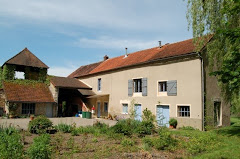
Saturday, 28 November 2009

The times they are a-changin’...

I have always liked the way the official holidays are celebrated here. In earlier Blogs I have mentioned several times what the most common procedure is; whether the wreath is available or not, whether the official speech, dictated by “Paris”, is read or not, to which of the two monuments we have to go this time, and the real highlight of every occasion, namely the opening of the boot of Monsieur P.’s car from which, through a rickety tape deck a crackling, whining Marseillaise will be played. Last Armistice day (11 November) it was yet again one of those occasions.
Traditionally the wreath laying takes place in Cormatin only. We were stunned, when we noticed that Monsieur P. had indulged in buying a brand new neat and tidy amplifier, on batteries, which hosted a cassette player and a microphone. The mayor could now use a microphone to address his audience, and the Marseillaise was this time actually recognisable as such. At the end the mayor invited everyone for a vin d’honneur, but that was not what Monsieur P. had in mind. He is the last survivor of Buchenwald in Cormatin, but that is not the only reason why Monsieur P. has authority in the commune. A week earlier there had been a celebration at the monument for the deportees, to commemorate the fact that the monument had been erected 60 years ago. Obviously Monsieur P. was not impressed with the turn-out that particular day, so he strongly suggested that the whole crowd (which was exceptionally big this day) should go to Bois Dernier as well, even though there was no wreath. A week before the monument had been enhanced with a new inscription and a flagpole from which the French flag was flying proudly. The inscription reads “Nous sommes libres, notre drapeau flotte à nouveau, ils ont fait don de leur vie.” ; which means something like “We are free, our flag flies anew, they gave their lives”. After a minute of silence the Marseillaise sounded like it had never sounded here before. Still, whenever I pass by one of the monuments, I think with a bit of nostalgia of how it sounded in the good old days.....

The website of La Tuilerie de Chazelle

Sunday, 22 November 2009

Christmas is looming

The year is slowly coming to an end, and this usually culminates in an overabundance of Christmas decorations in Chazelle and other hamlets or villages around us. But our hamlet has something special other hamlets do not have: Chazelle has on of the world’s greatest decaroteurs of all time. And certainly Monsieur N. gets his act together towards Christmas.
In the summertime his garden is inhabited by an army of garden gnomes, standing in front of their own wooden working model of a Dutch windmill, or leaning against a wooden model of a romanesque church. If you want to turn your garden into something like the one I have just described, Monsieur N. is definitely your man.
This year however, his winter urge started earlier than usual. At the end of last month, out of the blue, something appeared on the corner of the only crossroads Chazelle boasts. Seated on a fire hydrant there was a man carved out of pumpkins. This Halloween decoration was however aptly destroyed by, one assumes, a stray cat or dog. But nothing can stop Monsieur N., once Christmas is looming. Last week, quite unexpectedly, a romanesque church appeared in front of his house on a wooden table.
The space in front of the church doors was populated by figures from a nativity scene; or should I say from at least a dozen nativity scenes? Not long after that another table appeared in front of one of his garage doors, this time carrying a huge wooden stable, inhabited by what appeared to be the remainder of his grand total of nativity scenes. But that is not all. The walls of his house are now decorated with numerous tasteful light bulbs, light snakes, roof and chimney climbing Father Christmasses, etc. In a word: his house breathes Christmas from all its pores.
But the best still has to come. Each year appears, next to the aforementioned fire hydrant, a Christmas tree and something that either resembles a coffin, or a rocket monsieur N. has built for his great-grand children. This monstrosity of course has lights, but it also contains another Father Christmas, half hanging against the wall of his coffin, ready to be launched into outer space.
When one has something like this next door, who would want to travel to London for the pathetic decorations in Oxford Street?

The website of La Tuilerie de Chazelle

Saturday, 14 November 2009

A delayed funeral

Recently, during a lunch of the Amicale de Cormatin, our mayor was in a very talkative mood. It all started off with talking about the main dish. That consisted of a stew of game, which he had shot himself during one of his hunting expeditions in the woods around Mont Saint-Romain. The wine flowed abundantly, and the stories got taller. At some stage there was a story about the bell-ringer of Chazelle. One day he rang the bell with such vigour, that the rope disattached itself from the bell, landed on the head of the ringer and almost knocked the guy off his feet. Since that time no bell has ever been rung, because there is no access to the bell from within, and obviously nobody has felt the urge to fix it from the outside. From there the subject changed to funerals. Our mayor had a relative in Paris, who died there. But the funeral was going to take place in Chazelle, where the family grave is, and everything had been arranged with the funeral director in Paris. The coffin would leave Paris at 9h00, and would arrive in Chazelle well in time for the funeral at 15h00. Everything was set for the event; the family had gathered in the church, the priest was there… The only thing that was not there, was the coffin. One and a half hour later the priest was getting cheesed off, and wanted to call off the whole thing. In the end he decided to do a symbolic funeral of a portrait of the deceased, and after that everybody moved off. In the mean time Paris had been phoned a number of times, and finally Head Quarters came back with the solution of this mystery. It appeared, that the driver had entered Chazelles into his GPS receiver. Not only are there at least 4 places with the name Chazelle in France; there are even more villages or hamlets with the name Chazelles. The driver had not just miss-spelled the place name, but also randomly picked the first one that came up in his tomtom. He emerged somewhere in Puy-de-Dôme, and after finding out his mistake, reached the proper Chazelle at about 21h00. The funeral turned out to be a very lonely affair in the end…. Moral of the story: Never trust your tomtom blindly!

The website of La Tuilerie de Chazelle

Saturday, 31 October 2009

Virtual reality

One of the highlights of a visit to the abbey of Cluny is the 3D film shown as part of the visit. But (I think as part of the Cluny 2010 celebrations) the Cluny abbey is introducing more things to show what the abbey looked like before the French revolution. One of the latest things introduced recently are screens which display “virtual reality”.
The screens are a sort of LCD screens, approx. 50 cm wide and 1 m tall, standing on a pole. The screens can be turned by the spectators. What one sees on the screen is what one would haven seen in the days the abbey was still there. The view changes when the screen is turned. in French these screens are called “bornes”, which meens something like milestones. The first one was installed in the remaining part of the transept. This one can be turned 360 degrees, and shows the views inside the church from the transept.
In the past the abbey was protected by walls, gates and towers. one of these towers is the Tour des Fromages, whis is located on Cluny’s main street. recently a second borne has been installed in the attic of this tower. It follows the same concept. the moment the screen is turned slightly, the view changes. The interesting feature is, that when one comes close enough to the screen to see the week market at the foot of the tower, the same market, and the people walking around it, are shown on the screen. Only the background of the market has changed to the abbey in pre-revolutionary days.
To me this is a stunning piece of modern virtual reality technique, and it certainly adds something to a visit of the abbey and of the tower (which requires a separate ticket). Apart from this Virtual Reality screen is the tower worth a visit in its own right. The access to the tower is inside the Office the Tourisme, and the wooden stairs are extremely steep. Once having climbed the stairs, one finds an attic with big holes in the walls (no windows) which allow stunning views of Cluny and surroundings. And one can take pictures of the lovely panoramas without being hindered by the glare of glass.

The website of La Tuilerie de Chazelle

Saturday, 17 October 2009

Pidgin German

Ever tried to translate some English prose into a language one hardly masters? Based on one’s education (in my case 1 year + 2 years German in various schools) and experience (none) this is not necessarily a doddle. When I was young, having a C or D for German was still seen as a belated act of resistance, hence why bother working hard to boost your knowledge of the German language?
Anyway, recently I wanted to post something in German on the Internet. A friend of mine, an ex-teacher (in German) agreed to take out the blatant errors, on the condition that this was going to be a one-off. This was my first encounter with German since the sixties. Was it sheer arrogance that made me revive the idea to have our website in English, Dutch, French and …. German?
I will not bore my readers with a detailed run down on my struggle with declinations, three genders, conjugations, four grammatical cases, uppercase for nouns, etc. What I would like to make clear is that some obsolete dictionaries and an ancient grammar book are not really sufficient for a smooth, quick and adequate translation, no matter how one simplifies the original text. Luckily there is a vast array of tools available on the Internet, and cross referencing with Wikipedia in Dutch, English, French and German, using Google to search for a word one assumes exists, and using the German Wiktionary helps tremendously. Still, it is a heavy task to produce something that does not automatically results in a declaration of war, as soon as a German reads the final product.
After three days of hard and concentrated work we now have a German website. Someone might actually remark that there are free translation programs available, such as Babelfish. To show the “quality” of those programs, I will translate the previous sentence from English to German and back to English again, using Babelfish.
1. Someone might actually remark that there are free translation programs available, such as Babelfish.
2. Jemand konnte, dass es die vorhandenen Programme der freien Übersetzung gibt, wie Babelfish wirklich erwähnen.
3. Someone could that there are the existing programs of the free translation, how Babelfish really mention.

Of course this a fictitious, and not completely fair test; however it certainly shows that free translators do not produce much more than pidgin German. I am convinced, that my translation is full of errors. However, read out aloud, with the right Prussian accent, it certainly sounds like German!
Mit freundlichen Grüßen, Käse aus Holland.

The website of La Tuilerie de Chazelle

Saturday, 3 October 2009

The local Chinese

One of the returning questions from friends and relatives is “What do you really miss in France?”. Most are thinking along the lines of Dutch delicacies like raw herring, but one of the things I missed most is the ordinary Chinese-Indonesian restaurant, which you will be able to find even in a small Dutch village. Around here there are some Chinese restaurants, but most of them are originally Vietnamese, which nowadays have taken on board Chinese and Thai food. We have tried a few, in Mâcon and Chalon, but the quality of the food was, to say it kindly, not impressive. When we were renovating the house, we went regularly to Crèches-sur-Saône, because that was where the nearest building merchant was. Almost all shops close between 12 and 2 o’clock, and of course one day we forgot, and were there just past 12. However, we had seen a sign nearby, saying “La Route de Chine, buffet à volonté”, and we decided to have lunch there in stead of driving half an hour back and return around 2 o’clock. That turned out to be a very lucky gamble indeed. The buffet à volonté (eat as much as you like) offered a very good choice of proper Chinese food; the quality was good and the price was very reasonable (€ 11.00 without drinks). After that event we tried to plan our trips to the building merchant in such away, that we could have lunch in Crèches as well. But all good things come to an end, such as the renovation and hence our visits to Crèches. However, we had to go to Mâcon regularly, because Mâcon is the seat of many offices important to us: the prefecture, the health insurance, the tax office, etc. On one of our trips we noticed another sign, saying “Palais d’Asie, buffet à volonté”; thinking of our good experiences with “La Route de Chine” we decided to give this one a try as well. That was definitely the end of our visits to Crèches. The choice in Mâcon was not only bigger, but the quality of the food was even better, and the price (in those days) was € 10.00 for a lunch. Since then the prices have been raised first to € 11.00, and recently lowered to € 10.50 (prices in the evening and week-end tend to be slightly higher). To give an impression of the assortment: there are 6 warm starters, 2 kinds of suhi, 2 kinds of dim sum, 4 sauces and various types of salad available. There are 8 hot meat, fish or shell fish dishes, which can be eaten with Cantonese rice, white rice, fried noodles, vegetables and even French fries. The desserts are various fruit salads, 5 kinds of ice cream and cake. In a word, there is something for everybody. Nowadays we plan our visits strategically around lunch time. And as far as the original question is concerned; the Chinese has been scrapped off the list, and is replaced by something that is really not available in France : an ordinary Dutch snackbar!

The website of La Tuilerie de Chazelle

Thursday, 24 September 2009

The end of an era

In my last Blog I was rather lyrical about the “old-fashioned” cattle market in Saint-Christophe. Unfortunately I was not aware of the changes that had taken place in the meantime. There was an article in the latest bimonthly magazine of the Chamber of Commerce about the market in Saint-Christophe. The article very proudly announced the introduction in June this year of a “marché au cadran”, which is a market by means of a clock. Because we had not been there for a while, we decided to see how dramatic these changes were.

The moment we arrived we saw what had happened. The traditional market still exists, but at a much smaller scale. Next to the old covered market hall a new building had appeared, a modern circular building. Inside the building was a small ring, with around it a sort of amphitheatre. One man brought a cow or cows in from the outside, and made them make a little round in the arena. In the mean time all the particulars, such as vaccinations, weight, lot number, etc. were displayed on a big screen. The farmers were bidding electronically, this time in Euros, although the price in Francs was still displayed as well, and after the highest bid the cow was lead outside the arena, to make place for the next one. It is needless to say that the sterile environment and the efficiency has advantages for farmers as well as cows. However, it is, at least for the tourist lacking the charm of the noise, the smell and of manoeuvring around heaps of cow dung, in order to see what is going on. For those who want to see an old fashioned market in its full glory, the motto is : do not wait too long. It looks like that within a year the old market will completely be replaced by the bidding via a clock. Something similar already has happened to the other big cattle market in Burgundy, the one in Moulins-Engilbert (Nièvre).
The blow was finally softened a bit by an excellent lunch at La Tour d’Auvergne. For € 13.30 we got steak frites, a cheese platter and a mousse au chocolat. Ever been to a restaurant, where, because one of the steaks was a bit on the small side (according to the waitress, they looked the same to us!) the cook had thrown in an extra, third steak? It happened to us that day!

The website of La Tuilerie de Chazelle

Sunday, 20 September 2009

Cattle market

When I look out over the meadows from my windows, I see some beautiful white Charollais cows (bred for meat, with AOC, and not for milk) wondering through the field. That is less strange than it seems; although we do not live in the Charollais region (Charolles is approx. 60 km from here) these sort of cows can be found throughout Saône-et-Loire. In the département there are two markets where this cattle is sold. The most important, biggest and oldest is the one in Saint-Christophe-en-Brionnais, a village even further from here than Charolles.
The market possibly dates back to the X-th century; in 1488 Charles VIII declared the market to be “perpetual”, and ever since there have been cattle markets here. We arrived at about 12h30, and the streets were completely deserted. All we saw were a few market stalls along the main street selling rubber boots. A bit disappointed we walked into a restaurant, it being lunch time. Here it was the same thing; a tiny room, with a few empty tables. We waited a few minutes, until a waitress walked in. We told her that we would like to have lunch, and the moment that magic word was spoken we were whisked away to the back of the restaurant. All of a sudden it became clear. The actual restaurant on a Wednesday (market day) was a great big hall, with endlessly long tables and benches. The hall was completely filled up with noisy farmers, obviously already having started negotiations about cattle prices at the lunch tables. The waitress found us a place, and we joined a bunch of shouting farmers at their table. The restaurant was run like a factory; very efficient. There were lots of waitresses, whizzing around the tables; unlike some busy French lunchtime restaurants around here, there was plenty of choice (although not à la carte), and not just one set menu. Within half an hour one had finished his meal, and made place for yet another farmer. Around one o’clock the hall emptied, but for a handful of tourists, and obviously that was the time the market started. The market is held in an immensely big hall, where the farmers are negotiating the prices by writing offer and demand on little bloc notes. It appears, that prices are still in Francs, although by now I do not think they are still using old Francs.
Farmers here are, as they were in the Netherlands, easily recognisable. French farmers however are generally scrawny, wear blue or dark-blue dust-coats and green or brown rubber boots, unlike Dutch farmers; the common denominator is the walking stick they carry around to hit the cows when necessary. Even though the farmers are different, the whole atmosphere on the market, with its smell of cattle and dung, the shouting and the negotiating, brings back memories from when I was a child, when I wondered across the weekly cattle market in Delft, the place where I was born. Every so often we still go back to Saint-Christophe, to taste the atmosphere, but also for lunch. Those lunches are excellent; of course no restaurateur would dare to come up with a lousy piece of meat when you serve farmers who breed what they are eating….. Saint-Christophe has two restaurants, but we find that the one we tried during our first visit, La Tour d’Auvergne, has, although the same sort and quality of food as the other, the better atmosphere of the two.
Click here for part 2.

The website of La Tuilerie de Chazelle

Tuesday, 15 September 2009

Cluny 2010 - Ouvrez les portes!

My better half has written a very interesting Blog about Cluny and its history, in view of the festivities around 1100 years Cluny Abbey. In stead of copying it in, it seems more logical to give the link to the Blog.
Click here to read Sue’s blog.
The Blog gives a very good written impression of how big and influential the monastic order of Cluny has been. Unfortunately there is not much left of the third church built there, but when visiting the remains of the church one can admire a 3D film, produced by the ENSAM, which shows what the Cluny church must have looked like in its high-days.
In the eighties I have seen a similar project from the Massachusetts Institute of Technology (MIT - Cambridge MA); however, if I remember correctly, that was not a 3D film, but an ordinary 2D film. Although it also showed what Cluny must have been like, the emphasis in that film was much more on what the MIT could do, than on what the monks around 1000 AD could do.
The film from the ENSAM is short (10 minutes) and in French, but is far superior compared to the 30 minute film from MIT.
Apart from this film there are a great number of models of the abbey around; the abbey museum hosts a very nice collection of various models, showing the exterior as well as the interior of the church.
The only part of the church that is still in tact is part of the transept; on the picture it is the right hand side part with the small tower with the blue roof and the slightly bigger tower next to it.
Click here for a photo album of “Ouvrez les Portes!”

The website of La Tuilerie de Chazelle

Monday, 14 September 2009

Frog legs

As a child I was told that there were actually people who eat frog legs. In English this does not sound so horrifying, but the Dutch call them frog bottoms, and who would want to eat some creature’s bottom? Of course, in those days I was not aware that steak is just a nicer word for cow bottom! When I lived in Singapore, one of the (Chinese) consultants I worked with, thought it was big fun to take westerners to restaurants where they served 100-year eggs, blood cubes, snake and turtle soup, iguana and frog legs. Even though I never got the hang of a couple of these things, frog legs certainly became one of my favourites. Some time ago we wanted to try out Le Rochefort, a restaurant in Cluny. It was packed each lunch time and the car park was full of local cars; normally a very good sign for a restaurant around here.
Unfortunately I had had escargots (snails Burgundian style) and frog legs a couple of days before in a different restaurant. Both dishes were served in a rather fluid sauce, completely covered in parsley (quite a common way to serve this sort of food around here). The plate with frog legs resembled a bit too much a stagnant pond covered in duck-weed with frogs floating in it (the frog legs are still attached to each other when served). Anyway, I ordered something else in Le Rochefort that day. However I saw several plates with frog legs being served around us, and they looked a lot more appetising than the ones I had had before.
A couple of days ago we decided to give it another go. And that turned out to be an excellent choice. The prices give here are the 2009 prices. One portion of frog legs costs € 21.00; a set meal (I chose Terrine foie de volaille = chicken livers, frog legs and desert) costs € 25.00.
Luckily I had shared the excellent starter with my partner, because the main course was so big and labour intensive, that I actually had eaten more than enough after an hour picking meat off minuscule bones. The desert went also to my partner, who was quite happy with the salad she had ordered and my leftovers. The frog legs were fried or deep fried, and were seasoned with parsley. Yesterday, when we were having a picnic at long tables with the inhabitants of Cormatin in the streets of Cluny to celebrate the opening ceremony of Cluny 2010, the conversation veered at some point towards local delicacies. After having been informed on how to catch snails, how to feed them flour for two days and then how to dissect and prepare them, the word frog legs fell. The consensus appeared to be that the best frog legs in the area are being served in, indeed, restaurant Le Rochefort in Cluny. A piece of advise of those who happen to stay around here and are adventurous with food : do not forget to have a meal there, and order a portion of frog legs. It is well worth the money, and not only is it famous in this part of the woods, but also delicious; take my word for it!

The website of La Tuilerie de Chazelle

Wednesday, 9 September 2009

Postman Pat

Delivering post can be quite tricky in a country like France. Apart from big towns and cities, smaller towns, and certainly villages and hamlets in the Campagne do not have street names, let alone house numbers. A village like Cormatin was given street names about two years ago; however house numbers still do not exist.

Whether one has the courtesy to inform friends and relations that the address “Bourg 71460 Cormatin” can be replaced by e.g. "Rue de la Sablière, 71460 Cormatin” is entirely up to this person. Most of the 500 inhabitants in Cormatin still live, as far as the addresses on their letters are concerned in the “Bourg” (bourg = village, town). The only people with a proper address are the ones who live in house with a name, such as “La Filatiere, 71460 Cormatin”. And although Cormatin now has street names, the online telephone directory still gives all inhabitants the same address “Bourg”. When one clicks on the “town map” option, all Cormatinois live in the same house, indicated with a star somewhere in the middle of the high street.
Hamlets like Chazelle do not even have street names. Hence everybody lives in “Chazelle, 71460 Cormatin”, again with the exception of those living in a house with a name, e.g “La Tuilerie de Chazelle”.
The postal code is not much use either; 71460 is an area with a radius of approx. 15 km, with 34 communes. And each commune has a handful of hamlets as well.
This system, or lack there of, has serious consequences for the Postal service. The lady who drives around like a lunatic in her little yellow car delivering mail (we estimate that she delivers in approx. 30 villages and hamlets) must know everybody by name! Hence it is obligatory to have your name displayed on your letter box.
As a consequence, whenever our Post lady is going on holiday, she always drives around with her temporary replacement sitting next to her for at least a week, in order for him or her to learn names and addresses by heart.
Is not it amazing, that (as far as we know) hardly any letters get lost? The only problem we have encountered in the beginning was how the French look at, in their eyes, strange names. All my official mail is addressed to “Cornelis van Halderen”, and in a nearby village of Ameugny another Durtchman lives with the name “Cornelis van X”. One day the post lady had to deliver a letter to this “Cornelis van X”, stopped reading at “Cornelis van”, and since we were first on her route, decided that there was only one “Cornelis van” in 71460. We solved this the next day, by handing over the letter to her, but whether this had been a one off or not, of course we do not know…..

The website of La Tuilerie de Chazelle

Saturday, 5 September 2009

Treasure hunt (part 2)

Click hear to read part 1 of this story.

Since we live here we have been looking out for other tile making factories in the vicinity, if only to get a bit more information on how these factories worked in the past. We thought we more or less found them all, until two of our gîte guests came back from a cycle ride, and told us enthousiastically “We have found another tuilerie nearby!”. What else could we do but get our bikes out, and have a look for ourselves? Indeed, we found this tuilerie in Saint-Forgeuil and had a chat with the owner. The man, a Belgian, knew of a few other tuileries around here. We knew then, in 2008 of the existence of seven factories (including his and ours), and he knew the location of three more. One of them, according to the man, was “easy to find, and well visible from the road between Joncy and Chevagny-sur-Guye”. The other two were indeed easy to find, but no matter how often we drove the distance between Joncy and Germagny, we did not find that one. In the end we decided that the man had made a mistake.
However, a few months ago we had a meeting with some people about a randonnée which would stop at our tuilerie for a vin d’amitié. And during this meeting the guide of the randonnée, who lives near Joncy, mentioned that particular tuilerie. We finally got a detailed IGN walking map out of the area, something we should have done long before, and found the tuilerie along that road. And again we got into the car, and drove off to investigate the road between Joncy and Chevagny-sur-Guye. We stopped at the given location, parked the car on the westside of the road, and crossed the road to the eastside, the side where on the map it said “tuilerie”. There certainly was a building, but at this time we are quite good at spotting tuileries or remains there of.
The building we were looking at had no resemblance to a tuilerie what so ever. we studied the map again, and came to the conclusion that maybe there had been a tuilerie once, but that there was no trace of it to be found any more. We crossed the road again to get into the car, when all of a sudden I saw a trace of a roof through the abundant foliage of some trees. We had parked on the edge of a small field, overgrown with stinging nettles and a cluster of trees. Once I had waded through the field, I saw, in between the trees, the remains of a drying shed (séchoir) and a kiln (four)! We finally had found our last tuilerie, we thought. However, the same gîte guests who pointed out the tuilerie of Saint-Forgeuil, had bought a book about the Voies Vertes in Burgundy. And this book mentioned a working tuilerie in Corbigny (in Nièvre, a bordering department). This was not exactly next door, but when it comes to tuileries, there is nothing to stop us. We visited the place, got an excellent guided tour by one of the workers, and learned a lot of things we did not know before (thanks to Paul and Jany).By then we thought we really had found everything there was to know. However, when I was surfing on the net this morning, in search of some updated tourist information, I came across an advert for a gîte in Lancharre (a hamlet near Chapaize) on the website of Chapaize. In the mean time we have visited the place, got a warm welcome and a tour from the owners, and we are now waiting for a counter visit. And again, we are finally complete ….. until another tuilerie emerges!

Click here to see the latest update of photographs of tuileries in Burgundy

The website of La Tuilerie de Chazelle

Wednesday, 2 September 2009

Philistine

Sometimes, wondering through a museum, an exhibition or just through the streets one stumbles on a piece of art. Sometimes it is clear what it is, a bust or statue of someone, or a sculpture of playing children. Other times it is not so clear what it depicts, and that goes for abstract art as well as for figurative art. And when you find out the name or title, it often obscures matters in stead of giving you an “Aha-Erlebnis”.
A good example is the sculpture by the famous Dutch sculptor Wessel Couzijn, which brightens up the Unilever Building on one of Rotterdam’s busy streets, the Weena. I like this piece of art, although it does not look like anything. My partner, who worked for Unilever for many years called it the “Scrap metal heap”, which certainly describes it well, and shows her appreciation for it.
But does the “meaning” of the sculpture becomes clearer when one knows the real title? I doubt it very much. The sculpture is entitled “Embodied unity”. I can imagine the “Aha-Erlebnis” displayed on the faces of my readers…
Despite this sort of abracadabra I really do like the sculpture.
I had a similar experience recently, when we visited the studio of Monique Dégluaire, a sculptress (who makes ceramic sculptures) living in the nearby hamlet of Bessuge. the woman makes beautiful stuff, and one day we decided to pay her a visit. Click here to join us.
One of her works stood in the garden, not in the studio. I actually should say sat in the garden , because it was a statue of a seated woman with a ball on her head. The woman had a hairdress like Cleopatra in “Asterix and Cleopatra” (one’s got to know his classics!). People with a bit more artistic feeling should stop reading here, because the following shows my ignorance when it comes to the deeper feelings of art and artists. I am a Philistine deep in my heart, and I feel quite happy about it. Anyway, I asked the sculptor casually what the name was of this Egyptian beauty, and I got my answer. She was called “La consolation des tempêtes”, loosely translated as the “Consolation or consoler of the tempests”. February this year we had a tempest raging across France, bringing down two trees in our garden, and breaking the overhead electricity cable. I wonder who needs consolation, the storm or the victims of the storm? Or is it the idea that the tempest consoles its own victims? Ask those who lost relatives and goods in the February storm that ravaged the western parts of the Netherlands in 1953. I still clearly remember that night in 1953, when the whole family stayed up until the small hours, listening to the radio, fearing that a nearby dike would break and inundate Delft and surroundings, while the “consoling” noise of the tempest was howling around the house…
Of course this has got noting to do with the beauty of the said work of art. Despite its name it is something I would not mind having in the garden.
The moral of this story: do not ask for the name of a piece of art when you like it; sometimes it is better not to know at all!

The website of La Tuilerie de Chazelle

Tuesday, 25 August 2009

The Russians are coming!

Last week we had encounters with a few people who once, not so long ago, were seen as sworn enemies of the “free” Western world.
The first encounter was during a rather bizarre bicycle accident. We decided to travel by car to Bonnay, in order to visit a guy who makes beautiful wooden miniatures. In stead of taking the main road, we decided to drive along a narrow country road. We had just crossed the Voie Verte at Cormatin, when we saw a female cyclist coming towards us, cycling in the middle of the road. The moment she saw us, something very strange happened. We had already stopped, when we saw her body moving forward over the handle bars, while at the same time the back wheel moved up in the air, and the bicycle landed on top of the woman. Once we got out of the car, it seemed that the woman was laying in a pool of blood. Fortunately things looked graver than they were.
We helped her up, untangled the bicycle and found out that she was a young Russian woman, staying in Taizé. She was sent out by a friend on the (borrowed) bike to get some shopping from Cormatin. Then it became more or less clear what had happened. The woman was carrying a very heavy rucksack, not on her back but in a little basket hanging in front of the handle bars. The basket further contained some bags of fruit and a bottle of wine.
Another bottle of wine she held in her hand whilst cycling. Obviously she was not a very experienced cyclist. When she saw us coming towards her, she panicked, and braked with her free hand. The free hand operated the front brake. This combined with the centre of gravity of her luggage and shopping, made the bicycle topple over, and she went with it. The blood she was bathing in appeared to be the content of two bottles of wine. Once we got her up and standing, she seemed alright, although very shaken. We decided to take her to Cormatin by car, to see at least a pharmacist, and if necessary a doctor. So Sue drove off with our new Russian friend, and I followed them on her bike. At the pharmacy they checked and cleaned her wounds (mainly grazes, also under her cloths) and, although the pharmacist actually wanted her to see a doctor, the woman insisted on leaving for Taizé. So we put the bicycle, luggage and shopping in the boot of the car, and brought her back to Taizé. Some people might think something higher was involved in this accident: the intake of alcohol is frowned upon in Taizé, and those staying their get only very few vouchers which they can spend on alcohol in the Taizé-run café……
Our second encounter with Russians took place the same week. The choir “Les Voix de la Nèva” from Saint Petersburg was performing in the Saint-Philibert abbey church of Tournus.
Those concerts are usually of high standard and hence very popular, reason why we had bought tickets well in advance. The choir was indeed excellent. The five men and five women performed a beautiful concert. Their voices sounded beautiful, not in the least because the acoustics of the abbey church is superb. Before the break they sang a program of Russian-Orthodox church music, and after the break they sang a collection of profane songs. One of the high lights of the last bit of the program was a stunning performance of “Vecherniy zvon”. The English title is “Evening bells”, and interestingly enough, the lyrics are a translation of Thomas Moore’s poem “Those evening bells” (Irish melodies, 1808). For those who want to hear the melody click here.
This week had a very high nostalgia content. Not only brought it back sweet memories of a very popular Russian language TV course which I once followed (only sweet memories came back, and hardly any Russian words!), but the song brought back memories of a very popular radio program from my youth. Each broadcast was dedicated to a specific firm, company or factory, of which the employees could request certain tunes to be played. And one of the very popular tunes was : indeed, “Vecherniy zvon”, performed by a very popular Dutch choir!

The website of La Tuilerie de Chazelle

Les Rendez-vous de Cormatin

One of Cormatin’s big theatrical events, Les Rendez-vous de Cormatin, has come to an end. This year there were quite a few French classics on the program, such as plays from de Musset and Appolinaire. We always like to see at least one of the plays, but this year there was noting to our liking. In previous years we saw amongst others Chekov’s “The Cherry Orchard” and Brecht’s “The Three Penny Opera” (in French entitled funnily enough “L’Opéra de quat’sous”!).
We thought that we should give the Festival a miss this year, until we discovered at least one interesting concert (the theatre group also hosts some musicians or cooperates with musicians from around here). The concert was called “Entre Paroles et Musique” with compositions by Gabriel Fauré. We should have figured out from the title that this was not only a musical evening, but we did not. It appeared to be an evening describing the life of Fauré, recited by two actors of the theatre group, alternated with Fauré’s music. The text also contained poems by contemporaries of Fauré. The music was played by Guy Touvron - trumpet and Chantal Rou - piano. The actors were from the “Studio Asnières”, a theatre group based near Paris which comes to Cormatin every year to “do” the festival.
Click here for the website of Studio Asnières.
Guy Touvron is a well-known French trumpet player, who is also the founder of the Festival Guitares en Cormatinois. Click here for Guy Touvron’s website.
Despite the language problems (listening to French poetry is distinctly more demanding then chatting to the baker about the weather) it was a very pleasant evening. The music was of a high standard, as might have been expected from a guy like Touvron.
As tradition wants it, the last Sunday of the Festival was closed off with fireworks in the gardens of the Château, followed by the inevitable vin d’honneur. And this closing event is not just for visitors of the festival; the whole population of Cormatin is invited, and turns up as well!

The website of La Tuilerie de Chazelle

Monday, 24 August 2009

Fête du village

When we arrived here in 2005, we did not have the foggiest idea what was happening in the villages around us. Slowly we started to built up a circle of friends, mainly through our French lessons. A couple of times a year our French teacher organises a soirée, where one meets his or her fellow students.
And all these people (mainly British) were talking over and over again about the village party in their village, and what they had to do to turn it into a success. One had to help set up the tables, another had to help out with the barbecue, etc.
And although we want to be part of our village, we were never aware of any village party. To fathom why we did not know, a little geography of the village might help understanding this.
When we go through Chazelle, e.g. to go to Cormatin, we have to take a road that is literally skirting the village. Along this road there are a number of houses; most of them are uninhabited; either because they simply are empty, or because they are second homes. As far as we know, there are is only one house permanently occupied. From this road there are three other roads, more or less perpendicular to the main road, going up hill, direction church. Hence the real village is situated on top of the hill, around the church. That is where all 30 permanent villagers live, including the mayor of Cormatin.
Last year, at the yearly brocante on 14 July, we bumped into the mayor’s wife. She told us, that the village party was going to be held on 4 August, and that we would receive an invitation. Lo and behold, a few days later we found an invitation in the letterbox. We phoned the contact person to find out what we were supposed to do (oh, just bring some wine and nibbles), and at the same time he told us why we had never been invited previously. Nobody really knew we existed, because everyone thought our house was part of the commune of Bray, and not of Cormatin. It was only because the mayor and his wife were on the committee this year, that they remembered to invite us! So we finally managed not only to be invited to wreath layings, but to the village party as well!
This year was our second village party. Contrary to last year, when a suckling pig was provided by the owners of “Le Petit Soif” (a cluster of houses, one of which is owned by the mayor), this year the set-up was a bit more sober. We had to bring 100 plastic plates and cups, and others donated wine, snacks, food for on the barbecue, cutlery, etc.
We think it is certainly thrilling to meet one’s fellow villagers. Even if half of them live most of the year in Paris, Lyon, Switzerland or other places……

The website of La Tuilerie de Chazelle

Friday, 21 August 2009

Flooding

When our guests ask for it, we do a little guided tour along the remains of the old tile factory. We always start were the process of tile making started, i.e. at the clay pit in our filed. The occasional guest asks how it is possible, that a tiny little stream like the Grosne could have produced any significant amounts of clay. Of course clay sediments are not deposed overnight; the deposit is a matter of centuries. And that the Grosne in the summertime looks like a peaceful little brook, does not mean that it is always like that. In spring or autumn this little river can flood huge areas around here, especially when melting snow from the nearby hills combined with heavy rainfall in the area makes the river swell to proper river proportions.
It is not unknown to us, that under those circumstances the Grosne is a piddly little stream, and by lunchtime it has turned into a seething river, inundating the surrounding meadows and demolishing the protection of the banks. We have experienced floods about three times now. The last time even the road between Chazelle and the D981 (the road to Cormatin) was closed by the pompiers, and a few houses along that stretch were inundated as well.
Fortunately these things do not happen too often. the first time we experienced a flood at this scale was in April 2006, the last time in November 2008. On the pictures the height difference is well illustrated. On the first picture one can see, that the difference between the roof of the lavoir (washing place) and the level of the Grosne (water already approx. 75 cm above normal) is approximately 1.75 m (my height).
On the second picture the water has risen to the edge of the roof, hence approx. 2.5 m.
In the morning, on my way to the baker, the situation was as in picture 1. By lunchtime the same day the water had risen to the level on picture 2.
At that time the meadows around us were inundated, the road was closed, and everybody was wondering what to do about two pregnant mares that got caught on a protruding knoll. Luckily for the owner, in the late afternoon the horses could be rescued without any damage!

The website of La Tuilerie de Chazelle

Wednesday, 19 August 2009

Campsite contest

This is going to be one of my shortest Blogs. My learned assistant, Mrs. Nixon Phd etc. (Oxbridge) has done some statistics, and there is nothing I can add to this. For those who like to know:
Click here

Tuesday, 11 August 2009

Another cat

A couple of days ago Sue got a phone call from friends in Vaux (a village 11 km from here), that a birthday present had arrived for her. The fact that her birthday is not due for another 2 months, and that these friends had no way of knowing when her birthday was, made us very curious indeed.
So off we went to Vaux, to see what present Santa had brought us. Our friends were having dinner the previous night, when a little stray cat walked in. They gave it something to eat, and it kept lounging around their house. Seeing this as an act of God, knowing our “need” of a cat in view of the mouse and mole population, they decided to donate the cat to us. They lent us a cage, and told us that we should not let the cat out of the cage for at least a couple of weeks. That is easier said than done, having to put up with the soft but persistent moaning coming from the cage. We let the cat out as often and as long as possible, which makes it purr like a Singer sewing machine. In the meantime we have bought a leash, and although either the lead is too big or the cat is too small, and it manages to worm its way out every so often, we can now let it wander around the garden in search of, at least that is what we hope, mice and moles.
Hopefully in the near future we will have a cat wandering around the house, who would like to stay here…..
Click here to see part one of this saga.

The website of La Tuilerie de Chazelle

Tuesday, 4 August 2009

Dog Latin?

The nearby village of Ameugny hosts a beautiful Romanesque church. It is one of many in this region; the abbey of Cluny has certainly left its traces in the area. The church is built of beautiful yellow stone, which has a stunning effect when the late afternoon sun shines on the church.
There is a tympanum above the church door, which may not be unique; however it is special in its own way, because the stone mason who made the tympanum has left his signature on it. On the lintel, at the bottom right hand corner, the following words are carved: “SEGVIN LAPIFEX MALEI”, which means “SEGUIN, STONE MASON FROM MALAY”. Malay is one of the many villages near here, with its own inevitable Romanesque church. I would have loved to make a picture of this signature, but my knowledge of cameras, light and photo editors was insufficient to come up with a photo showing a legible text. Fortunately one of our gîte guests has been teaching photography in the past and still is a keen photographer. He offered to help out, and he has not only taken the photos I wanted, but also made a collage of the various interesting parts of this tympanum. In the arch there is a central circle with an E carved in it. Funnily enough this E strongly resembles the Euro sign €! Around the circle four words are displayed. The whole thing must have been something like a mediaeval rebus. None of the words has an E in it. After filling in the E in the right place, the words “LX DI VRA ST” are transformed into “LEX DEI VERA EST”, which means as much as “Gods word is the truth”. The photograph attached is the collage made by Paul Geels (thanks a lot, Paul!). For those who cannot get enough of Romanesque churches, please click here to see more. The page is a first set-up of a collection of photos of churches in the area. They are ordered by post code and then alphabetically; this makes finding them on a map easier.

The website of La Tuilerie de Chazelle