Showing posts with label History; Architecture. Show all posts

Saturday, 22 May 2010

Living history

The nerve centre of all information in a small village like Cormatin is undoubtedly the local Tabac. Everybody visits this shop either daily or weekly, to buy the local paper, cigarettes, a magazine or a greeting card. During one of my visits I noticed an announcement, saying that the following evening a lecture would be held with as subject Cormatin and the resistance during WW II and the influence of general de Gaulle in Burgundy.
The connection between those two subjects was not immediately clear, but that would undoubtedly be revealed during the lecture. And although we were expecting guests for our gîte that day, we had decided that on early arrival of those guests (which they did) we could attend the evening. So on the night concerned we drove up to Salle Beun, the village house, where everyone in our village who could read was gathered.
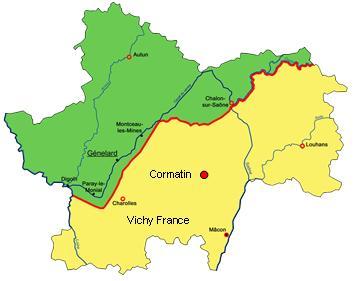
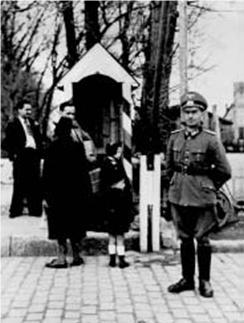
The object of this particular Blog is not to give a run down on the lecture itself. But one has to admit, that Gilles Plattret, historian, writer, journalist, politician and lecturer (he appears to be quite popular as “conférancier” - meaning stand-up comedian in Dutch! - in Saône-et-Loire) delivered an excellent story about how the war started, what the influence was of the line of demarcation (which ran not far from Cormatin) between “free” Vichy France and its occupied northern counterpart, when and how the resistance movement started and what the influence was of de Gaulle in ’40-’45 in communities like Cormatin. The lecture was illustrated with a projection of images of this period. No need to say, that those who were born and brought up in Cormatin regularly threw in remarks and comments about the contents of those pictures.
What I found most interesting during the presentation was the personalized way Plattret interacted with his audience. Of course our Monsieur P. was prominently there. Plattret told several anecdotes, in which Monsieur P.’s father (deported and victim of the camps), and Monsieur P. himself (deported and survivor of Buchenwald) played an important role. But not only Monsieur P.’s name was mentioned. Several (even for us) well known names were mentioned, of whom in many cases the descendants were amongst the audience.
This evening proved to me that a presentation about history, no matter how well documented and presented, certainly gains accessibility for a bigger public when the presenter somehow has personal ties with the subject and with the audience itself.
I was well impressed. and I will keep an eye out for the name of Gilles Plattret as of now.

For our own website click here.

Monday, 1 March 2010

The tempest

The short slideshow accompanying this Blog shows some pictures of the flood in the Netherlands in February 1953 and France in February 2010.


Whenever there is a gale blowing around the house I start feeling restless and uneasy. It brings back memories of the big flood of February 1953 in the South-Western part of the Netherlands, which inundated a big part of the country. I was a child then; I was not allowed to go to bed that night, which I, as a child, thought was extremely exciting.
My mother had prepared a little bag with “valuables”, which stood in the corridor, ready to be taken with us in case we had to be evacuated. I lived in Delft at the time, which lies approx. 1 meter below sea level. My father was glued to the radio (of course we did not have TV in those days) waiting for the message that one of the crucial dikes near Rotterdam had caved in, in which case Delft and surroundings were under serious threat of being inundated.
The days after the tempest were also very strange; my school was a collection point for clothing and blankets for those who lost their home due to the flood. Also slowly film coverage became available in the news reels of the cinemas; as said before, TV was hardly known then. When the French coastal region was under “vigilance rouge” (the highest alarm level) Burgundy was under vigilance orange. Contrary to February last year, when we were severely hit by a tempest, this time Xynthia skirted Burgundy. However, in the evening news of February 28 I recognised the same images; houses just poking out of the water, people being carried out of their houses, helicopters rescuing peoples from roofs....
The death toll in the Netherlands in 1953 mounted 1800; the flood in France made approx. 50 deadly victims. And no matter how different the scale of both events was, the desperation transmitted by the TV images was he same in 1953 as in 2010.

The website of La Tuilerie de Chazelle

Saturday, 28 November 2009

The times they are a-changin’...

I have always liked the way the official holidays are celebrated here. In earlier Blogs I have mentioned several times what the most common procedure is; whether the wreath is available or not, whether the official speech, dictated by “Paris”, is read or not, to which of the two monuments we have to go this time, and the real highlight of every occasion, namely the opening of the boot of Monsieur P.’s car from which, through a rickety tape deck a crackling, whining Marseillaise will be played. Last Armistice day (11 November) it was yet again one of those occasions.
Traditionally the wreath laying takes place in Cormatin only. We were stunned, when we noticed that Monsieur P. had indulged in buying a brand new neat and tidy amplifier, on batteries, which hosted a cassette player and a microphone. The mayor could now use a microphone to address his audience, and the Marseillaise was this time actually recognisable as such. At the end the mayor invited everyone for a vin d’honneur, but that was not what Monsieur P. had in mind. He is the last survivor of Buchenwald in Cormatin, but that is not the only reason why Monsieur P. has authority in the commune. A week earlier there had been a celebration at the monument for the deportees, to commemorate the fact that the monument had been erected 60 years ago. Obviously Monsieur P. was not impressed with the turn-out that particular day, so he strongly suggested that the whole crowd (which was exceptionally big this day) should go to Bois Dernier as well, even though there was no wreath. A week before the monument had been enhanced with a new inscription and a flagpole from which the French flag was flying proudly. The inscription reads “Nous sommes libres, notre drapeau flotte à nouveau, ils ont fait don de leur vie.” ; which means something like “We are free, our flag flies anew, they gave their lives”. After a minute of silence the Marseillaise sounded like it had never sounded here before. Still, whenever I pass by one of the monuments, I think with a bit of nostalgia of how it sounded in the good old days.....

The website of La Tuilerie de Chazelle

Saturday, 31 October 2009

Virtual reality

One of the highlights of a visit to the abbey of Cluny is the 3D film shown as part of the visit. But (I think as part of the Cluny 2010 celebrations) the Cluny abbey is introducing more things to show what the abbey looked like before the French revolution. One of the latest things introduced recently are screens which display “virtual reality”.
The screens are a sort of LCD screens, approx. 50 cm wide and 1 m tall, standing on a pole. The screens can be turned by the spectators. What one sees on the screen is what one would haven seen in the days the abbey was still there. The view changes when the screen is turned. in French these screens are called “bornes”, which meens something like milestones. The first one was installed in the remaining part of the transept. This one can be turned 360 degrees, and shows the views inside the church from the transept.
In the past the abbey was protected by walls, gates and towers. one of these towers is the Tour des Fromages, whis is located on Cluny’s main street. recently a second borne has been installed in the attic of this tower. It follows the same concept. the moment the screen is turned slightly, the view changes. The interesting feature is, that when one comes close enough to the screen to see the week market at the foot of the tower, the same market, and the people walking around it, are shown on the screen. Only the background of the market has changed to the abbey in pre-revolutionary days.
To me this is a stunning piece of modern virtual reality technique, and it certainly adds something to a visit of the abbey and of the tower (which requires a separate ticket). Apart from this Virtual Reality screen is the tower worth a visit in its own right. The access to the tower is inside the Office the Tourisme, and the wooden stairs are extremely steep. Once having climbed the stairs, one finds an attic with big holes in the walls (no windows) which allow stunning views of Cluny and surroundings. And one can take pictures of the lovely panoramas without being hindered by the glare of glass.

The website of La Tuilerie de Chazelle

Tuesday, 15 September 2009

Cluny 2010 - Ouvrez les portes!

My better half has written a very interesting Blog about Cluny and its history, in view of the festivities around 1100 years Cluny Abbey. In stead of copying it in, it seems more logical to give the link to the Blog.
Click here to read Sue’s blog.
The Blog gives a very good written impression of how big and influential the monastic order of Cluny has been. Unfortunately there is not much left of the third church built there, but when visiting the remains of the church one can admire a 3D film, produced by the ENSAM, which shows what the Cluny church must have looked like in its high-days.
In the eighties I have seen a similar project from the Massachusetts Institute of Technology (MIT - Cambridge MA); however, if I remember correctly, that was not a 3D film, but an ordinary 2D film. Although it also showed what Cluny must have been like, the emphasis in that film was much more on what the MIT could do, than on what the monks around 1000 AD could do.
The film from the ENSAM is short (10 minutes) and in French, but is far superior compared to the 30 minute film from MIT.
Apart from this film there are a great number of models of the abbey around; the abbey museum hosts a very nice collection of various models, showing the exterior as well as the interior of the church.
The only part of the church that is still in tact is part of the transept; on the picture it is the right hand side part with the small tower with the blue roof and the slightly bigger tower next to it.
Click here for a photo album of “Ouvrez les Portes!”

The website of La Tuilerie de Chazelle

Saturday, 5 September 2009

Treasure hunt (part 2)

Click hear to read part 1 of this story.

Since we live here we have been looking out for other tile making factories in the vicinity, if only to get a bit more information on how these factories worked in the past. We thought we more or less found them all, until two of our gîte guests came back from a cycle ride, and told us enthousiastically “We have found another tuilerie nearby!”. What else could we do but get our bikes out, and have a look for ourselves? Indeed, we found this tuilerie in Saint-Forgeuil and had a chat with the owner. The man, a Belgian, knew of a few other tuileries around here. We knew then, in 2008 of the existence of seven factories (including his and ours), and he knew the location of three more. One of them, according to the man, was “easy to find, and well visible from the road between Joncy and Chevagny-sur-Guye”. The other two were indeed easy to find, but no matter how often we drove the distance between Joncy and Germagny, we did not find that one. In the end we decided that the man had made a mistake.
However, a few months ago we had a meeting with some people about a randonnée which would stop at our tuilerie for a vin d’amitié. And during this meeting the guide of the randonnée, who lives near Joncy, mentioned that particular tuilerie. We finally got a detailed IGN walking map out of the area, something we should have done long before, and found the tuilerie along that road. And again we got into the car, and drove off to investigate the road between Joncy and Chevagny-sur-Guye. We stopped at the given location, parked the car on the westside of the road, and crossed the road to the eastside, the side where on the map it said “tuilerie”. There certainly was a building, but at this time we are quite good at spotting tuileries or remains there of.
The building we were looking at had no resemblance to a tuilerie what so ever. we studied the map again, and came to the conclusion that maybe there had been a tuilerie once, but that there was no trace of it to be found any more. We crossed the road again to get into the car, when all of a sudden I saw a trace of a roof through the abundant foliage of some trees. We had parked on the edge of a small field, overgrown with stinging nettles and a cluster of trees. Once I had waded through the field, I saw, in between the trees, the remains of a drying shed (séchoir) and a kiln (four)! We finally had found our last tuilerie, we thought. However, the same gîte guests who pointed out the tuilerie of Saint-Forgeuil, had bought a book about the Voies Vertes in Burgundy. And this book mentioned a working tuilerie in Corbigny (in Nièvre, a bordering department). This was not exactly next door, but when it comes to tuileries, there is nothing to stop us. We visited the place, got an excellent guided tour by one of the workers, and learned a lot of things we did not know before (thanks to Paul and Jany).By then we thought we really had found everything there was to know. However, when I was surfing on the net this morning, in search of some updated tourist information, I came across an advert for a gîte in Lancharre (a hamlet near Chapaize) on the website of Chapaize. In the mean time we have visited the place, got a warm welcome and a tour from the owners, and we are now waiting for a counter visit. And again, we are finally complete ….. until another tuilerie emerges!

Click here to see the latest update of photographs of tuileries in Burgundy

The website of La Tuilerie de Chazelle

Tuesday, 4 August 2009

Dog Latin?

The nearby village of Ameugny hosts a beautiful Romanesque church. It is one of many in this region; the abbey of Cluny has certainly left its traces in the area. The church is built of beautiful yellow stone, which has a stunning effect when the late afternoon sun shines on the church.
There is a tympanum above the church door, which may not be unique; however it is special in its own way, because the stone mason who made the tympanum has left his signature on it. On the lintel, at the bottom right hand corner, the following words are carved: “SEGVIN LAPIFEX MALEI”, which means “SEGUIN, STONE MASON FROM MALAY”. Malay is one of the many villages near here, with its own inevitable Romanesque church. I would have loved to make a picture of this signature, but my knowledge of cameras, light and photo editors was insufficient to come up with a photo showing a legible text. Fortunately one of our gîte guests has been teaching photography in the past and still is a keen photographer. He offered to help out, and he has not only taken the photos I wanted, but also made a collage of the various interesting parts of this tympanum. In the arch there is a central circle with an E carved in it. Funnily enough this E strongly resembles the Euro sign €! Around the circle four words are displayed. The whole thing must have been something like a mediaeval rebus. None of the words has an E in it. After filling in the E in the right place, the words “LX DI VRA ST” are transformed into “LEX DEI VERA EST”, which means as much as “Gods word is the truth”. The photograph attached is the collage made by Paul Geels (thanks a lot, Paul!). For those who cannot get enough of Romanesque churches, please click here to see more. The page is a first set-up of a collection of photos of churches in the area. They are ordered by post code and then alphabetically; this makes finding them on a map easier.

The website of La Tuilerie de Chazelle

Thursday, 9 July 2009

Tuileries in Bourgogne (1)

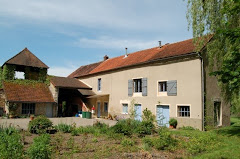
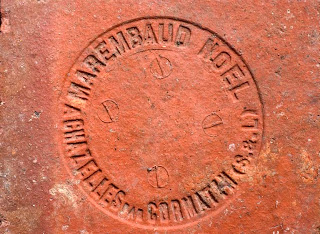
It may be clear by now that we live in a tuilerie; to be more precise, in La Tuilerie de Chazelle. Chazelle is a small hamlet and part of the community of Cormatin. When we came here, we thought that a tuilerie was a roof tile factory. However, we found out that at least in in this part of Burgundy a tuilerie does more than just making roof tiles. Actually, we are not even sure whether this factory has ever produced any roof tiles at all. We have found numerous floor tiles, rectangular bricks and wedge shaped bricks with the inscription of the founder of the factory “Marembaud Noël, Chazelles, Cormatin, S&L”, but we have never found a single roof tile amongst the rubble where we found the others.
The founder of this factory, Monsieur Noël Marembaud, lived from 1855 to 1936. The previous owner of La Tuilerie de Chazelle, the grand daughter of Monsieur Marembaud, told us that the factory stopped production in 1924; then it was turned into a small holding. If we assume that the guy started his factory at the age of 30, the factory must have been producing bricks and floor tiles over a period of approx. 40 years.
Tuileries are usually located near a river (because of nearby clay sediments, in our case from the river Grosne), outside a village (because of the smoke pollution) and at the edge of a forest (because of the availability of fire wood). In the area here, which houses a number of rivers, such as the Grosne, the Guye, the Grison and the Saône, there are quite a number of old tuileries to be found, some in good shape, others completely run down. Some photographs of the various tuileries in the vicinity can be found on the following web page. Some Tuileries in S&L (71)
How did a tuilerie work? The clay was dug from a nearby quarry with shovels, and transported to the place where the clay was mixed. The clay mixer was a big barrel with a heavy mixer, which was propelled by horse power. When the clay, after adding water if necessary, had achieved the right consistency, the clay was formed into bricks by a brick press (one at a time!). After the bricks were formed, they were stored on a sand bed in the séchoir or drying shed. These séchoirs were usually long, low open buildings, where the wind had free play in order to dry the bricks naturally. The bricks were ready to go into the oven, when the sound they produced whilst the artisan was hitting one brick with the other had the right pitch.
the "four" or kiln is a very primitive “furnace”; it is usually a tall square tower with a roof, and big ventilation holes right underneath the roof. The walls are very thick. The kiln of La tuilerie the Chazelle has inside dimensions of 2.75 x 3.15 m (9’ x 10’-6”) and 1.8 m (6’) thick walls. The total height is approx. 10 m (34’), and the distance between grade level and the underside of the smoke or ventilation holes is approx. 5.5 m (18’). A kiln has two entrances. The lower entrance at grade level is approx 70 cm (2’- 4”) wide and 1.75 m (6’) high; the higher entrance lies opposite the lower one at 1.75 m (6’) up to 3.5 m (12’) and is 1.75 m (6’) high as well. Obviously they used the lower entrance when starting stacking the bricks up to a level of 1.75 m (6’). After having filled up most of the kiln area up to this height, they could not access the kiln any more from this entrance, and hence the filling continued through the second entrance up to a level of 3.5 m (6’). Once this level was reached, ladders were place outside the kiln against the walls, and the last layers of bricks or tiles were lowered from above through the ventilation holes. With regards to the stacking, there was one peculiarity. It was not enough to stack the bricks in such away that there were gaps between the bricks.
Our kiln has two tunnel shaped openings in the walls at ground level (which are now bricked up, but clearly visible). The first stones where stacked in such a way, that they formed a tunnel from the fire tunnels in the wall to the wall on the other side. Once the two tunnels were formed, the stacking continued the normal way. The bricks were stacked first, on top of the bricks the floor tiles were stacked, on top of those came the roof tiles, and the highest layer consisted of lumps of lime stone. Once the kiln was filled up, the entrances were bricked up and the fires were lit. The fire tunnels were filled up with faggots, and when these burned well, the fire was fed with logs and finally with coal. The whole process took about a month, from loading, firing, cooling to unloading. The capacity of our tuilerie was very small.
Assuming that the production consisted of bricks only, each cycle produced approx. 16000 bricks. Winter was used to get wood from the forest, but of course no clay could be dug from the quarries. there were possibly only four cycles per year. However, most houses in this area are built of stone, and bricks were mainly used for decoration around door and window openings. Hence the supply of bricks was possibly more or less equal to the demand.
As far as we know there is still one traditional tuilerie active in Bourgogne. The Tuilerie de la Chapelle de Sarre in Corbigny, Nièvre (58) still produces wood fired bricks, floor tiles and roof tiles. The factory has worked uninterrupted for 250 years. The old kiln however, although still in tact, has been replaced by a four room kiln, where the production is circulating continuously. Hence there is always one room being loaded and heated up, one fired, one is cooling down, and the last one is being unloaded. And although a proper factory, and not a tourist attraction, we were given a very interesting guided tour by one of the friendly workers there.
Click here to read the continuation.

The website of La Tuilerie de Chazelle

Friday, 26 June 2009

Patriotism

The website of La Tuilerie de Chazelle
Blog of La Tuilerie de Chazelle by Sue

The French are very proud of their past. The fall of the Bastille in 1789 is celebrated with great vigour throughout the country, and every little village has got fireworks on that day, or at least a brocante or vide grenier in the main street, which turns passing through the village into a nightmare.
But a great past has also its shadowy sides. The French have lost a tremendous amount of young men during the Great War, and on 11 November, Armistice day, again every village has a wreath laying ceremony at the omnipresent war memorial.
Our commune (Cormatin) forms no exception. Interestingly enough, Cormatin has two war memorials.
In front of the church there is the monument for those who fell during WWI, WWII and the colonial wars, and just outside the village, near the hamlet of Bois Dernier, lays the monument for those who were deported to the various concentration camps by the Germans. This monument has an urn with sand from Bir Hakeim, a piece of stone with Buchenwald written on it, which was brought to Cormatin from Buchenwald by one of the survivors, Monsieur P., and a quotation from one of the radio broadcasts General de Gaulle made from London in 1940.
The ceremonies in Cormatin follow a strict logic, although, strict…..
The last Sunday in April is the (national) Remembrance Day for the deportees. Until recently there were two survivors of the camps in the village, but now only Monsieur P. is still there. He is the one who knows how everything works, or should work, in the village. A wreath is laid at Bois Dernier only.
8 May is Liberation day, and wreaths are laid at the Cormatin and Bois Dernier monuments. The same applies to 14 July. On the 11 November a wreath is laid only in Cormatin.
That is how it should be. But our Mayor is not always as interested in these things as he should be, and sometimes he is a wreath short, or has one too many, and then one can hear the grumbling of some grumpy old man: “I told you, we never go to Bois Dernier on this day!”.
Not all these ceremonies are well attended.
One of the least popular is 18 June, in commemoration of General de Gaulle’s call to arms addressed to those who lived in France. The procedure is quite simple. At a given time everyone gathers at the Mairie (town hall does too much honour to this run-down building!), and when the Mayor sets the example, everybody goes to his or her respective car, and off we drive to Bois Dernier (about 500 m from the Mairie). That walking is not done, must have something to do with the way the French go from one place to another, which is preferably not on foot. That the average age of the participants plays a role as well, would not surprise me.
This year the participation was minimal. Half the city council was not there, only a handful of Sappeurs-Pompiers turned up, and also quite a few of the “ordinary” citizens were not there. The mayor was supposed to read a letter from the Minister of the Interior, but that part was skipped after consultation with Monsieur P. The mayor put the flowers on the monument, and then there was the obligatory 1 minute silence, which last normally not much longer than 30 seconds. Next Monsieur P. read out the “Appel du 18 juin 1940”. The last part of the ceremony is always the best. Monsieur P. has a very old car, almost vintage, and in the back of it he has a cassette deck. He opens the boot, plugs in the deck, inserts a cassette, and then the racket starts. His cassette deck and cassettes must be as old as his car, which makes understanding a 1940 radio broadcast recording not exactly easy to follow. After the Gaulle’s speech the Marseillaise is played, which sounds like it was recorded under water.
After all this is over, the Mayor invites all participants for a vin d’honneur at one of the local bars (they all get their turn).
And then it is time to clamber back into the cars, drive to the allocated pub, and enjoy a (free) glass of wine. That is also the time to catch up with the latest village gossip.
What one has to go through for a free glass of wine……