Showing posts with label Various. Show all posts

Saturday, 12 February 2011

And the winner is.....

Yesterday it was finally the big day; we had to play loto or bingo for those living outside Cormatin who had bought a number of cards.
Around five in the afternoon the Salle Saint-Roch started to fill up with villagers who came to play bingo in loco parentis. Quite some cards had been sold, so every player was in charge of a generous amount of loto cards. We both played on 12 cards each; the cards had been distributed randomly, so in theory nobody was playing the cards he or she had sold. After half an hour the first prize (a flat screen TV) fell. The card had been sold by one of our council workers to his father in law. The game continued, and the next prize fell on a card that had been bought by someone from Cormatin. The card was checked by one of the officials, and yes, it contained all the correct numbers. The game was just about to continue, when somebody else rather sheepishly shouted “Bingo”. And this card turned out to be a winning card as well. When more then one card wins at the same time, each potential winner grabs a bingo ball from a bag; the highest number wins the prize, and the lowest number gets a consolation prize (often a small pot of paté from the supermarket). In this case the late comer had won. The winning card was confiscated by an official, and she looked in her paperwork which person had sold the card with no. 354 and to whom.
The poor woman than had to announce the name: after several tries she came out with the name of a certain Pocahontas from Luxemburg, who had bought the card through Sue Nixon. It quickly dawned on us that the winner was one of our last year’s campers, who follows this blog regularly. His Lithuanian surname starts wit P., and slightly resembles Pocahontas.... He contacted us immediately after he read my blog about the loto for the Amicale and forwarded money to buy some cards straight away. However, winner or not, I have to disappoint him a bit: he did not win the espresso machine which he wanted, but a brand new cordless hoover; no misunderstanding, this is NOT an old hoover whereby someone has cut off the cable!
The other members of our network who have bought cards will receive an email from us telling them that they did NOT win. But we are 100 % convinced that everybody has bought cards for the good cause, and the Amicale de Cormatin will certainly see to it that the money is put to good use!

For our own website click here.

Saturday, 5 February 2011

Units of the world, unite!

Somebody who follows my blog on Facebook commented on my previous blog about fire wood. He lives in another part of Bourgogne, in the Bresse region, and apparently the wood there is not delivered and measured in “stères”, but in “moules”. Ever since I started work in the petrochemical industry, and got involved in working in the imperial units of length, volume, weight, force etc. I have been fascinated by the variations in archaic units; the Netherlands knew in the past at least 6 (six!) different inches, ranging between 24 and 27 mm, depending on the region. It is interesting to know, that although the metric system was developed in France during the French Revolution, the first head of state to enforce the metric system by law (in 1820) was the Dutch King William I. This fascination caused me to open the French Wikipédia and look up what they have to say about moules and stères.
The moule is a unit of volume for cut wood, which goes back to pre-(French)revolutionary times. And as with most ancient units, this one is also regionally defined. In the Savoie a moule measures 1.6 stères, in the Chablais, a part of the Haut-Savoie it measures 3 stères, and in Burgundy it is as much wood as you can get into a cube with sides of 1.33 m.
This last dimension is no doubt an equivalent of 4 ½ French feet or a number of other local units. This boils down to a gross volume of 2.353 cubic metres. When 1 stère is equal to (effectively) 0.7 cubic metres, a moule should be 3.36 stères. However, my spokesman from the Bresse states that a moule equals 2.63 stères. A simple calculation makes 1 (Bresse) stère effectively 0.89 cubic metres. And that tallies with the rest of his story, wherein he tells that his wood is delivered in 1.3 metres lengths. One has to stack neatly, and hence economically, to stack 1.3 m lengths in a cube with sides of 1.33 m!

For our own website click here.
Wednesday, 13 October 2010

SnapIt

It sounds as a bit of a weird title, but I will explain in a second why I chose this rather strange title. A few days ago I received an email, offering me a licensed copy of the SnapIt software, if I was prepared to try the software out and write a review about it in my Blog. The name rang a soft bell, and I thought: why the heck not? So here it is!
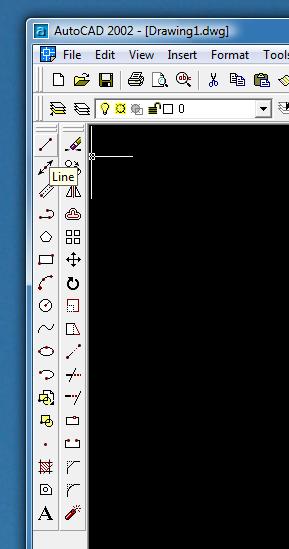
When I worked as an engineer in a big engineering office as a civil engineer, I was heavily involved in CAD development and training from a civil engineering point of view. No training is complete without training manual, but how do you explain to (often) not very experienced CAD users how to achieve something, like drawing a line?
The easiest way is to show it in a picture and combine it with an instruction.
Example :
1. Click on the “line” button in the left hand menu.
Etc.
I have always created these pictures using the “print screen” option, hence create an image of the full screen, use Control-v to insert the picture in my word document, and then crop it to size, and if necessary reduce or blow the picture up a bit.
Sounds quite tedious, and it was. I have created many a training manual using this rather long winded way.
We had SnapIt software in the office, but I seem to remember it was illegally obtained, and nobody could explain to me how it worked.
Nowadays, being a retired engineer, there is no need to write manuals any more. On the other hand, I have been using the above method not only in Blogs, but also in letters answering questions of clients involving e.g. street maps.
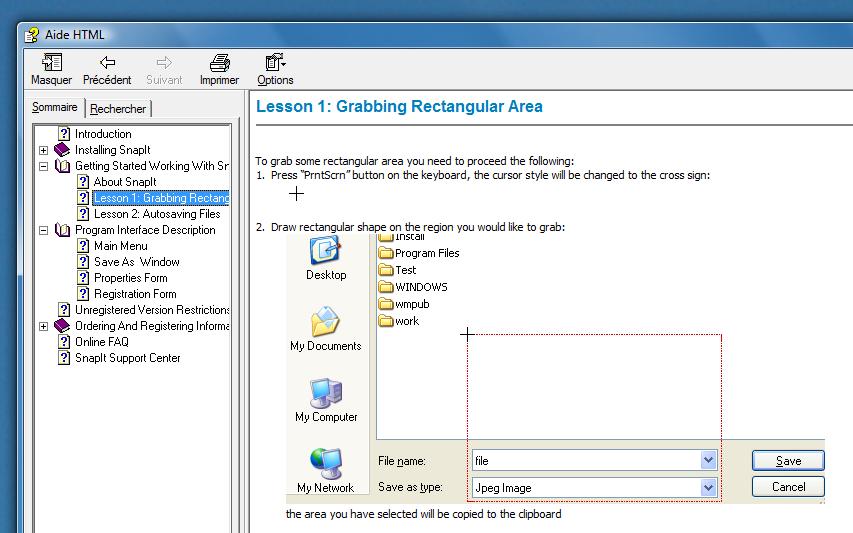
The SnapIt evaluation version I have now does the same thing as the PrintScreen option I have been using, only a lot quicker. The procedure is super simple. Assign a key to SnapIt (I chose F12).
Press F12, and the cursor changes into a crosshair. Click in the screen at the location you want to cut out, move the crosshair to the opposite corner, click again, and, depending on the settings, there will be a JPG , TIF or other picture format on your clipboard. You can either do a Save as of the picture, or use the Autosave option with pre-defined filenames, or copy the picture straight into a word document using Control-v.
The only flaw? What I have explained above would be easier explained if I could “Snap it”! However, I used SnapIt to snap part of a page of the documentation explaining how it works!

After I had kept my part of the bargain, I promptly received my registration code from the software provider, turning my trial copy into an officially registered copy. Julia Taylor, the representative, came up with the following suggestion for those who are interested in the software:
Please mention in your blog about a giveaway for your readers if they also create a review in any blog / forum / twitter / facebook, etc, and contact me with link to the review, I will issue a reg code and name for them.
So if you are interested, you can download a trial copy (click here for the link), then write a review and send details to Ms Taylor at julia.taylor@digeus.com, and Julia is your Aunt!

For our own website click here.