Showing posts with label Festival; Event. Show all posts

Saturday, 23 April 2011

Jazz et Caetera

In earlier postings I have tried to pay some attention to the jazz life in this part of France; see the postings about the Crescent Jazzclub in Mâcon and Jazz à Trivy. The last series (usually 5 concerts per season) can boast concerts by international jazz artists, such as quite recently by organ grinder Rhoda Scott.
Cluny itself hosts the yearly festival Jazz Campus en Clunysois. Having said this, I must admit that I never have been to one concert in the series. That is partially due to the fact that I am not well into the French jazz scene, and partially because I am not really interested in the work shops that are part of the festival.
The same thing holds for another festival around here, Jazz à Couches. The program shows quite a big number of big band concerts, and one can ask oneself whether it is still possible to maintain a good quality big band. The past has proven, in better jazz climates than nowadays’, that maintaining a good big band was only just possible for great band leaders like Basie and Ellington. Another drawback for me is that, although Couches is in Saône-et-Loire, it is not exactly next door for me.

Jazz et CaeteraJazz et Caetera is another organiser of good jazz concerts. Unfortunately Jazz et Caetera does not have a live website (anymore), but the paper as well as electronic newsletter luckily still works. Jazz et Caetera started off giving concerts in Château de Dravert in La Guiche, but the last few years they organise concerts throughout the region. In Châteu de Dravert I have seen an excellent concert by René Urtreger, the piano player who performed with Miles Davis during the recording of the sound track of “Ascensceur pour l’échafaud”. Michel Hausser, a well known vibraphone player in France, recently gave a concert in Château de Dravert, and Cluny as well as Messeugne hosted concerts by Austrian boogie woogie piano player Martin Pyrker.
Of course it is impossible to maintain that boogie woogie is still one of the leading jazz styles. Having said that, however, what has preference: enjoying an evening out in a nice ambience, listening to good quality “old style” music, or sitting in one’s living room, listening to a CD with more cotemporary jazz music?

For our own website click here.

Saturday, 16 April 2011

Mad cow’s disease

Professionally, but also leisurely, we are very interested in things happening around here which might be of interest for tourists, and hence for our guests, such as concerts, markets, castles, etc. Not only do we do research for our own tourist web pages, but we keep an eye out for similar information on other sites, not to copy, but to investigate to see whether we can use it for our own site.
One of our competitors, who is running a gîte not so far from here, mentioned on her website a cattle market in Charolles, which is a stone throw away from the weekly big cattle market in Saint-Christophe. I quote: “In the cattle markets of Charolles and St Christopher-en-Brionnais you can admire the Charolais, the best beef cattle in France”.
We know the Saint-Christophe market very well, but the Charolles market was unknown to us. So one sunny day we set off to explore this market, which, according to Mr. Google himself, was held every second Wednesday of the month, from January to May.
I quote Mr. Google’s result: ”Le marché aux bovins a lieu le 2e mercredi de chaque mois (transactions à 9h) de janvier à mai au Parc des expositions”.
When we arrived there, there was not a car in sight, there were no farmers, no cattle, let alone a market. When we inquired opposite the market hall, at the Maison de Charolais, we found out that there had not been a cattle market for years, because all cattle transactions were nowadays concentrated in Saint-Christophe.
Wondering outside I suddenly realised what could have been the reason for stopping the market; there was a whole bunch of stark raving mad cows grazing around the Maison de Charolais. And who wants to trade cows with those animals around?
Based on my professional background the phrase “Lessons learned” springs to mind.
Lesson learned from this day: never trust information given by your competitor!

For our own website click here.

Saturday, 26 February 2011

The holy corkscrew

Anyway, I was well impressed by the scale of the event. There were several hundreds of people in the procession, which started in Vaux, and climbed the short distance uphill to the church of Saint-Ythaire. The various Guilds had their banners and their different uniforms, whereby the “Chevaliers” of the “Confrérie” were not only carrying their Saint Vincent, but also other paraphernalia. Their coat of arms depicts a cork screw and something resembling a hand grenade. Today we had a better look at this coat of arms and only now we found out that the holy hand grenade, on the other side of the holy corkscrew, was in reality a side view of a tastevin, a shallow metal, often silver platter which is constructed to display the colour of the (red) wine, and used by professional wine tasters. All members of the Confrérie were wearing a big tastevin around their neck, and one was carrying a huge corkscrew.
The mass was celebrated in a normal French way. However, because the church was chocker block full, and we were seated in a recess, right behind a bunch of 10 (ten) horn blowers; I almost got a heart attack when completely unexpectedly all ten of them decided to join the congregation in a song.
Then there was the inevitable wreath laying at the war memorial, followed by a vin d’honneur at the town hall.
But what is a fête in France without a lunch? After two o’clock we piled into the Foyer Rural of Saint-Gengoux, where I did a quick count; the tables were laid for 200 people. We found out quickly who did the catering; a company from Montchanin (about 25 km away) had brought over food, professional cookers and cooking utensils and prepared a stunning meal for all present.
Just to make you jealous:
Pâté de canard avec son foie gras et quelques feuilles;
Dôme de sole, queues d’écrevisses sauce du chef avec riz et fleuron;
Trou Bourguignon;
Souris de cerf braisé et ses légumes;
Fromage plateau servi avec noix et raisins;
Mignardises - Café.
And of course there were plenty of excellent local wines served with this meal....
At the end of the meal another ritual had to be performed. A few members of the communes involved were invited to join the Confrérie, and some were even appointed “Chevalier”; they were given the accolade by means of what we have dubbed the holy corkscrew.
As usual with these sorts of events these lunches last at least four hours, after which the real diehards go on dancing until the wee wee hours. We however are spoil sports in this respect; after the last cup of coffee we were completely worn out, and only wanted to go home. And the fact that the band was in shrill contrast with the rest of the day had not much to do with our wimping out, after an excellent day....

For our own website click here.

Saturday, 19 February 2011

The wrong Saint

January 22 is the official day of Saint Vincent, the patron saint of the wine growers. This is a festival that does not go unnoticed in this wine growing area, but having said that, because we live in a small almost wineless enclave, Cormatin itself is not really involved in this tradition. There is a yearly big festival for the whole of Burgundy, which is rotating yearly from village to village. The festival lost its importance at the end of the 19th century, parallel with secularisation of French society, but was revived in the late thirties, and last year 40000 people took part in the celebrations. In 2009 the Saint Vincent Tournante was held in the area of the Mâcon-villages appellation.
In places where there is still an active “Société de secours mutuelle” (something like a wine growers union, association or guild), in our part of the world united in a bigger society, the “Confrérie des Vignerons de St Geng de Vigny” (note the typical French subtle play on words - Saint-Gengoux or Saint-Jean and vigneron or vignoble), a yearly local St. Vincent festival is celebrated.
This festival also rotates every year, although in a much smaller area. Although not directly involved, we had heard from friends who live and are active in the local Amicale or Foyer Rural in the nearby village of Saint-Ythaire, that the local Saint Vincent this year was hosted by their village.
They have been busy for months, one evening a week together with other villagers, to fold paper flowers to decorate the village. Since we are involved in similar projects in Cormatin, we realised how big this event must be in comparison to “our” one night flower folding event for the yearly Téléthon. Anyway, we expressed our interest in this festival, and our friends kept us up to date. Recently we were issued with a program and an inscription form, we paid our entrance fee, and bingo, we were in for a day out on Sunday 7 February.
It turned out to be a misty day, when we turned up at 9h30 in Vaux, at a barn next to our friends’ house. They had indeed done a wonderful job in decorating the village. Not just in the village itself, but also along the roads leading up to Vaux and Saint-Ythaire there was an overabundance of Christmas trees along the streets, decorated with paper flowers.
The trees were partially donated after Christmas, partially freshly stolen from the surrounding woods. Also hedges and permanent trees were “flowering” in a sea of yellow, red, green, violet and blue. Apart from that, displays were made of various materials, whereby the number of “puppets” draped in wheelbarrows, surrounded by numerous empty wine bottles, suggested more than seven drunken nights. Of course nobody turned up in time; this is France after all. But by 9h45 sort of a parade was formed, headed by the various Guilds in their uniforms with banners and their own statue of Saint Vincent.
I dropped my proverbial clanger, when I saw Saint Vincent standing on a sedan chair, where the carrying structure clearly said “Saint-Vallerin”. I shouted out that these guys had brought the wrong Saint, not realising that it was the name of the village where this Saint Vincent lived, and not the name of the Saint itself.
Well, nobody is perfect....

To be continued

For our own website click here.

Saturday, 18 December 2010

Steam

We (almost) live along the old local railway between Chalon-sur-Saône and Mâcon (nowadays a cycle and walking track, the Voie Verte). The heavy duty railroad between those two towns is still in use, and follows more or less the Saône. Further, luckily outside earshot, there is the TGV line between Le Creusot and Mâcon. Whenever one wants to hear the sound of trains, one has to travel. One of the tourist attraction around here is the Parc des Combes in Le Creusot. Le Creusot is a former industrial town, in its heyday heavily involved in coal and steel industries. The Parc is mainly aimed at children, but it also hosts steam events every so often. Besides it offers home to one of the fastest steam locomotives ever built, the 241P17 .
It is not only here where the locomotive was restored and is maintained; throughout the year Le Creusot is the starting point for trips, often made in double traction with the Mistral - the name of the 241P17, to places like Mulhouse, Aix-en-Provence, Lyon, Dijon or Marseille, using the SNCF network. The loc was designed by the French engineer André Chapelon, the inventor of the Compound loc. I quote a friend of mine, an expert on steam and trains: “Compound machines are machines with small high pressure and big low pressure cylinders. The steam expands in two steps from boiler pressure to atmospheric pressure. When starting up all steam goes full on the cylinders; once at speed the compound cylinders are utilised. The machines are not easy to handle, but the French were experts at it.”
One can see the Mistral regularly in the neighbourhood, because quite a number of the train’s trips are coming past or through Chalon, Chagny, Tournus and Mâcon. In Chalon, Tournus and Mâcon there is normally a long stop to enable the Anoraks to shoot their films, photos or sound bites. The picture with this Blog was taken while the train came towards a viaduct near Chagny with a speed of approx. 100 km/h. What is more thrilling than seeing this piece of technical ingenuity ploughing through the beautiful Burgundian landscape?

The website of La Tuilerie de Chazelle

Saturday, 3 July 2010

Back to the future

Since I started this blog I have already written so many articles about the various ceremonies around here, that I have created a separate label for those pieces. Those interested in the continuing story of Monsieur P. and our mayor, and the struggle with modern technology of those two, can click on the label “Ceremony” in the right hand menu.
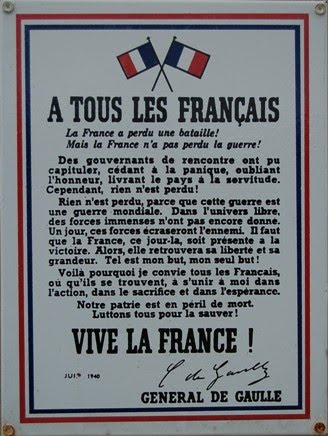
The call to arms of General de Gaulle in which he ordered the French to take up arms against the Germans in stead of collaborating with Pétain and his gang 70 years ago was celebrated big time this year in France. We were rather curious how the ceremony at Bois Dernier would go this year. Would Monsieur P. be able to handle the brand new amplifier, or would he again require the assistance of the flag carrier Monsieur N.?
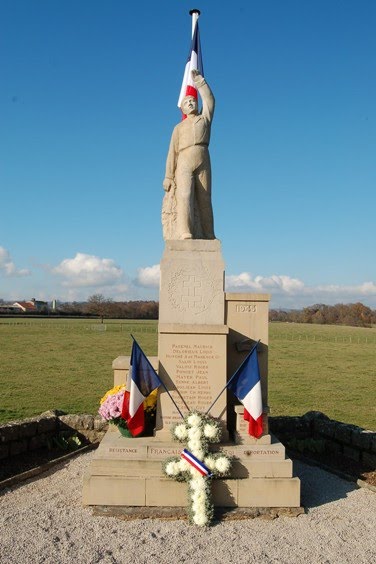
Around six thirty in the evening an extremely small group had gathered near the Mairie. It was really only a handful of people, which surprised us in view of the 70 years celebration of the event. Even the thriving force behind it, Monsieur P. was not there. Anyway, what had to be done had to be done, Monsieur P. or no Monsieur P. We were spread over fewer cars than normal, and the co-voiturage equippe drove off to Bois Dernier. To our relief we saw that Monsieur P. was already there, his car parked near the monument. After the wreath laying was done and after the mayor had read the speech from “Paris”, Monsieur P. asked one of the youngest pompiers, a girl in her early teens, to read out De Gaulle’s words. After this had been accomplished, it was time for the musical closure of the ceremony.

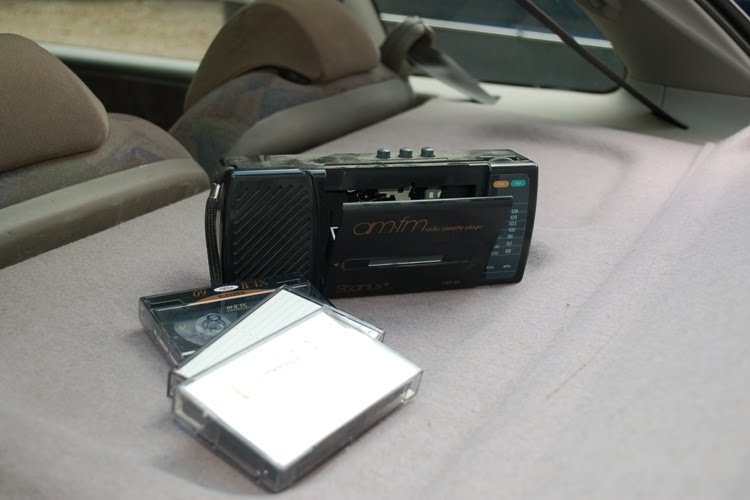
We were completely baffled when Monsieur P. walked to his car, opened the boot, and revealed to us his pre-historic cassette player. As if it had never been away, it churned out a shrieking, howling and crackling rendition of General de Gaulle’s speech (very authentic!), a ditto version of the Chant des Partisans and the best version of the Marseillaise ever played (apart from the one in Casablanca of course).
May we draw the conclusion that Monsieur P. has given up when it comes to modern technology? Time will tell....

For our own website click here.

Saturday, 19 June 2010

Country bumpkins and concert etiquette

It is summer, and hence festivals around here are all in full swing. Cormatin boasts each year two important festivals, the guitar festival (Guitares en Cormatinois - June/July) and the theatre festival (Les Rendez-Vous de Cormatin - July/August). The guitar festival is quite popular, also with tourists. Most likely music is much more accessible for foreigners than plays in French. Almost every year the opening of the guitar festival takes place in the romanesque church of Malay with a concert by the nationally well known French guitar player Emmanuel Rossfelder. This year he did not open with a solo concert; this time he accompanied the mezzo-soprano Yana Boukoff (of Yugoslavian origin) with a program called Viva España.
The program consisted of mainly Spanish music (not illogical, given the title), although the program also showed pieces like Bach’s “Jesus joy of man’s desire”, two pieces by Heitor Villa Lobos (Brasilian) and the well known aria from Bizet’s (French) Carmen “L’amour est une oiseau rebelle” (Habanera). As an encore they played Bach/Gounod’s “Ave Maria”, a German/French cooperation. But who cares, as long as the music is good! The program was nicely balanced between instrumental and accompanied vocal pieces. For me, as the father of a classical guitar player, it was really nice to hear again many pieces my son once had on his repertoire. There were “Andaluza” written by Granados, the famous tremolo piece “Recuerdos de la Alhambra” and the “Jota” by Tárrega, all played with gusto and technically perfect. And also the “Canciones antiguas” by Garcia Lorca were not unknown to me.
What I find very amusing during these sort of concerts in this environment is the (lack of knowledge of) concert etiquette. I have learned it, as many people, the hard way, e.g. by applauding at the wrong instant. And that certainly took me a number of concerts. I must say, that it all sounds easy for the average visitor of concerts, but what about those who rarely see the inside of a concert hall? Applauding during the performance? Very normal during jazz concerts; almost impolite not to clap after a solo. Applauding during an opera, after a beautifully performed aria? Perfectly ok, even shouting Bravo is allowed. Clapping after a good solo dance in a ballet? Nothing wrong with that either. But during a classical recital, after each part of “Seven popular songs” by de Falla? Ai, ai, ai, almost a deadly sin. It is also not uncommon, not to applaud in between pieces when the pieces are written by the same composer. But there are also exceptions to this rule....
I have to confess, that sometimes I lost count, causing me to applaud with the majority of the audience as well. Having said this, for those who lost count or do not remember whether a piece consists of three or four parts, it should be clear from the body language of the artists whether a piece is finished or not. Rossfelder for example raises his guitar demonstratively when he finishes his piece. But again, in this audience of farmers, ex-farmers or villagers the lack of etiquette seems to be no problem for the performers. Rossfelder as well as Boukoff were very grateful for every “illegal” applause. Most likely they thought to be better of with a public that did not exactly know how to “behave”, but was at least appreciating the music they played to the full extent!

For our own website click here.

Saturday, 15 May 2010

Village gossip

It may be clear from this Blog that village life in Cormatin is not dissimilar to the stereotypical life in the fictitious village of Clochemerle.
A previous posting got an unexpected follow-up.

Understanding of modern technology by older citizens and progress of this technology do not always go hand in hand. The new amplifier cum CD-player, recently obtained by the commune (and not, as I wrongly stated earlier, by our war veteran and deportee Monsieur P.) was supposed to make the most recent ceremony (the wreath laying at the Monument for those who gave their lives for France during the wars) last Liberation Day a feast for the ears. After the various speeches the Marseillaise was supposed to be played through the amplifier at an acceptable, but clearly audible volume. However, Monsieur P. had forgotten how the thing worked. After what seems to be an eternity, during which Monsieur P. pressed buttons, turned knobs, at the end assisted by the flag bearer, who had to lower the flag for this purpose, all of a sudden the Marseillaise blurted out over Cormatin at House Party volume. It was loud enough to wake the fallen from their graves. But the official part was not over yet. Once every heart had recovered from the sudden shock, the whole group moved off to the monument for the deportees, just outside the village. Those who thought that Monsieur P. had left the amplifier running, just to be sure, were wrong. This time he could not get the thing working at all. The crowd started to get a bit restless, but Monsieur P. had a solution: if the blooming thing would not work, we could beat it, by SINGING the Marseillaise! There are French politicians, who are adamant that foreigners and French should be able to sing and know the words of the Marseillaise. If these politicians had had their way, the performance would have been great. However, obviously they had not had their way, and the majority of those present hummed away, or (amongst others the mayor) kept their mouth shut.
Anyway, after this rather embarrassing intermezzo the mayor announced the venue of the vin d’honneur, and he also explained that a number of ex-combatants and/or resistance fighters would be presented with “Un diplôme d’honneur pour les vétérans de la Seconde Guerre Mondiale”. This had to be handled before the wine started to flow, and one of the “lucky” ones was Monsieur P. After this last eruption of the ceremonial part of the day, Monsieur P. said that he would like to say a few words. But instead of thanking Mayor and Government for this generous diploma, he complained about the fact that “Paris”, so many years after the events, could not come up with something better and more apppropriate than a shoddy piece of paper in flyer format. Every other word he used was “ridicule”. And I think, that most people present, including the Mayor, deep down in their heart agreed with what monsieur P. had to say that day.

The website of La Tuilerie de Chazelle

Saturday, 10 April 2010

Easter market in Louhans

For those who are following this Blog via Facebook or email: the accompanying slide show is only visible on the Blog itself.

We advise guests, who show a keen interest in markets, to visit the Monday market in Louhans. Not only is Louhans a nice little town, with a lively newspaper printing museum, but on Monday is boasts one of the best markets in the area. It is not really next door (35 miles), but the road leading there is pleasant and not very busy. The whole town has been turned into one huge market stall, where one can buy vegetables, fruit, meat, clothing, gadgets, household goods (even Tupperware!), etc. You will also find the occasional guy shouting out all the marvels his “magic cutter” performs on melons, tomatoes and the like.
The real attraction however is the “animal market”. At the edge of the town, just outside the centre, the market stretches out for another mile or so. Here they sell rabbits, goats, ponies, dogs, cats, ducks, chickens, etc. in all shapes and sizes. The buyers go home with there newly acquired friends locked up in cardboard boxes with air holes, to make sure their pets survive the journey.


One of the best days to visit this market is on Easter Monday. The town is seething with people (comparable to New Years Eve on Trafalgar Square), one has to park his car 1 mile before the centre of town. It would take half an hours drive, if not more, to reach a designated parking area at the edge of town from there. This Easter Monday was a beautiful spring day, hence most plants and trees were green and in full bloom. It seemed, like half the population of Saône-et-Loire had come to Louhans. The one thing which is impossible on a day like that, is to haven lunch somewhere in town. All restaurants were not only full, but also fully booked. The few stalls selling sandwiches had long queues of people waiting for their bite. Finally, we managed to buy a piece of pizza and a quiche at a baker near where we parked. Simple as it was, it tasted like manna from heaven!

The website of La Tuilerie de Chazelle

Saturday, 13 March 2010

Tour de France 2010

Cycle-racing in France is, like in Belgium and the Netherlands, a big thing. As soon as there is talk of a cycling event, no matter how big or small, they are omni-present; men, and sometimes women, dressed in brightly-coloured lycra, bent over their handle bars, whereby the first guy often shouts out loud and inarticulate words, or raise a hand or an arm to warn the crowd behind him for a pothole in the road, a walker, a parked car, or an aged person crossing the road.
And events there are plenty in France. In June, when the Tour de France fever hits France once again, many cyclists throughout the country start their own modest Tour de Village, Tour de Département, Tour de Région or even Tour d’Environnement. And each of these lycra-clad people has his own hero to project himself onto: Alberto Contador, Lance Armstrong, Jan Ullrich, Indurain, LeMond, or for the older ones Hinault, Mercx, Anquetil, Bahamontes...
Also Cormatin is not spared this ordeal. Last year, 2009, the Route de Saône-et-Loire (a race of four stages) passed through Cormatin. Hours before hand the roads were closed, in order to ensure free passage for the breakaway or for the peloton thus reducing the chance of nasty accidents. But this race is nothing compared to the real French classic, the Tour de France.
In 2006 the Tour did not (yet) pass through Cormatin, however the finish of the eighteenth stage was in Mâcon. Reason for some of our fanatic cycling fans to get on their bikes and cycle to Mâcon to experience the spectacle. They have been regular returnees to our campsite ever since! The next day the Tour continued starting in Le Creusot and finishing this time trial in Montceau-les-Mines. No doubt the cyclists were brought to Le Creusot by bus or train.
In 2007 the sixth stage (between Semur-en-Auxois and Bourg-en-Bresse, approx. 200 km) passed throug our village, Cormatin. From well before lunch until approx. 17h00 quite a number of roads were closed, amongst them the main road D981 from Cluny direction Givry vv., thus making space for the passing of the caravan followed by the cyclists. The circus certainly was in full swing; an endless row of hooting cars “decorated” with adverts, driving through the village at neck breaking speed, in the meantime throwing promotion material into the crowd; hundreds of spectators of whom several threw themselves almost in front of the cars in order to obtain that wonderful cardboard sunshade....
And then finally the climax, a coloured band travelling so fast that the faces of the racers were no more than a vague blur. That particular year we had quite a few campers on the site who had chosen to stay with us especially for this occasion. A couple of them were very keen to see an intermediate sprint at Brancion. Unfortunately they never made it, partially because of road closures and partially because they did not have a detailed enough map to avoid the main roads....
In 2010 anothe stage starts nearby Cormatin. The seventh stage starts on Saturday 10 July 2010 from Tournus (25 km) for a stage of 161 km to Station les Rousses. We are really curious which of our cycling die-hards will be staying with us again!

The website of La Tuilerie de Chazelle

Saturday, 30 January 2010

Jazz à Trivy

There is a very strong link between Jazz and France. Paris has acted as a magnet on a lot of great jazz musicians; after the war quite a few actually stayed in Paris for a shorter or longer period of time. Apart from this, France has produced some great names in jazz as well, to mention a few: Martial Solal, Daniel Humair, Pierre Michelot, Michel Legrand, Jean-Luc Ponty, Louis Sclavis and the unforgettable Quintette du Hot Club de France with Django Reinhardt and Stéphane Grappelly. The tradition of the Hot Club is still alive in a great number of “manouche” combos.
One day we were browsing around in the Office de Tourisme in Cluny, when we got hold of a brochure called “Jazz à Trivy”. One of the first concerts in that series was a concert of Biréli Lagrène and his Gipsy Project. In Cluny the tickets had been sold out, but they told us that tickets were still available in a pharmacy in Charnay-lès-Mâcon. Charnay is not so far from here (approx. 30 km) so the next day we had tickets. Everybody who knows something about jazz also knows that Lagrène had developed from being a Django clone into a musician with a fabulous technique and a very own sound, even though he still has not forgotten his manouche background. The concert was excellent, and two seasons after the first concert, Lagrène performed again in Trivy, this time with Gipsy Project and singer Sara Lazarus. And that is what I find so amazing. Someone like Lagrène can easily fill a big concert hall, and has done so in the past. And still, this guy gives concerts in a piss pot little town, in the middle of nowhere, in a small Romanesque church which can be filled, with a lot of difficulty and after much pushing and shoving, with a maximum of 100 spectators. I am pretty sure there is a simple explanation. Possibly Lagrène was born or has lived around here, or has got some friends who live in this area and whom he does a favour; or of course a combination of both. Whatever the reason, Lagrène is a very welcome guest in Trivy. And Trivy has more to offer. The Swingle Singers of Ward Swingle were scheduled to perform not so long ago. Anyway, for jazz fans who are staying here in the summer: keep an eye out for “Jazz à Trivy”!

The website of La Tuilerie de Chazelle

Monday, 7 December 2009

Charity (2)

The whole of Saturday 5 December was dedicated to the Téléthon, in the papers, on TV and in the streets of every self-respecting village and town in France. We have finally found out what the Téléthon is all about; it is a yearly nationwide fundraising event for a research institute for myopathy. Something like this on a yearly basis is unknown in the Netherlands, but maybe it is comparable with Red Nose Day in the UK. Each year another (mostly) French celebrity is godfather of the Téléthon, such as Alain Delon, Mireille Matthieu, Julien Clerc and this year the famous actor Daniel Auteuil (Jean de Florette / Manon des Sources). We also found out why this event is so important in Cormatin; one of the village children is suffering from myopathy, and with only 500 inhabitants almost everybody knows kid and parents personally.
We did not have time (and had no intention!) to sit and watch TV all day. After we had helped putting up the tents in front of the church in Cormatin, carried and put up long wooden tables, emptied car boots and carried boxes from car to tent, the Téléthon in Cormatin slowly got going after 10 o’clock. One tent was hosting second hand books, DVD’s and videos, another stall was selling mulled wine, snacks, wafers, ready made boxes with petit salé aux lentils (a typical winter dish from the North of France), in another women were making and selling Christmas decorations, and in yet another one they were selling roses. Throughout the day some children were playing guitar and accordeon, a local bicycle club had organised a tour around all Téléthons in the vicinity, buying something in every village, like a sandwich, some wafers, a glass of mulled wine....
Slowly it started to dawn why we had been making paper roses the week before. On the steps in front of the war memorial a huge board was mounted, with in it cut out the Téléthon logo. For each sold real rose (à € 1 a piece) a paper rose was stuck in the openings of the wooden board, thus producing a multicoloured Téléthon logo by the end of the day! Half the population was in the mean time trying to make the event a success, and the other half was supposed to hang around, buy roses or a second hand book, or spend money in any other way, thus enabling the organiser Monsieur P. to phone the central fund raising authorities to proudly announce that Cormatin had managed to clock up another € 4000 (roughly the average over the past years). This was not the first time that I had noticed that some Cormatinoises are very good in selling package deals. After we had helped putting up the tents we went off to buy the Saturday edition of Le Monde at the local Tabac. However, Mme B. did not let us leave with just Le Monde; we were more or less forced to buy two boxes of petit salé aux lentils. She was very persuasive, with arguments as “I have bought them myself as well”, it makes an excellent and easy luch, and it is for a good cause. Finally we did not leave the shop before we had dished out € 11 in return for two slips of paper entitling us to two boxes. We walked back to the stand with the snacks and in exchange for our pieces of paper we obtained the food, consisting of a layer of lentils garnished with various pieces of meat, such as streaky bacon, sausage and pork. How much the final result for Cormatin is going to be is still unknown; however, Mme B. did not exaggerate about the food; we absolutely do not mind to support next year’s Téléthon exactly the same way!

The website of La Tuilerie de Chazelle

Tuesday, 1 December 2009

Charity (1)

Because we are finally involved in Cormatin’s seething social life, we were asked to come and help out with “folding roses” for the yearly Téléthon. We still do not exactly know what this is, apart from a big national fund-raising event. Anyway, we were asked, and we said yes. We were one of the first to arrive, and once the lady with the key to the village hall arrived, we entered and started putting chairs around the table. Soon the crowd came in, one by one. For us it is every time a surprise who the volunteers are going to be; there seems to be a reservoir of about 50 people in Cormatin, who take turns in helping out
However, there is also a small hard core who is always there. This time the majority of volunteers were women.
Cardboard boxes were carried in, which were filled with pieces of crêpe paper in various colours, pliers, and rolls of thin metal wire, normally used in gardening. Once everything was distributed across the tables, the game could begin.
One takes the corner of an oblong piece of crêpe paper in one hand, and folds the bottom long side of the free hanging bit into an harmonica shape with the other hand, whilst pushing it in the first hand. This hand also slowly revolves the folded bit, thus creating something which, with a lot of fantasy, resembles a flower. The bottom bit of the flower is then secured with a piece of wire, whereby the extra length of the wire resembles a stem. And voilà, there is one of the 360 roses ready for.... yes, ready for what? We still have no idea. It involves selling real roses, and giving the paper ones away, or the other way around, or there might still be another possibility. Anyway, all shall be revealed on the day of the Téléthon.
To be continued...

The website of La Tuilerie de Chazelle

Saturday, 28 November 2009

The times they are a-changin’...

I have always liked the way the official holidays are celebrated here. In earlier Blogs I have mentioned several times what the most common procedure is; whether the wreath is available or not, whether the official speech, dictated by “Paris”, is read or not, to which of the two monuments we have to go this time, and the real highlight of every occasion, namely the opening of the boot of Monsieur P.’s car from which, through a rickety tape deck a crackling, whining Marseillaise will be played. Last Armistice day (11 November) it was yet again one of those occasions.
Traditionally the wreath laying takes place in Cormatin only. We were stunned, when we noticed that Monsieur P. had indulged in buying a brand new neat and tidy amplifier, on batteries, which hosted a cassette player and a microphone. The mayor could now use a microphone to address his audience, and the Marseillaise was this time actually recognisable as such. At the end the mayor invited everyone for a vin d’honneur, but that was not what Monsieur P. had in mind. He is the last survivor of Buchenwald in Cormatin, but that is not the only reason why Monsieur P. has authority in the commune. A week earlier there had been a celebration at the monument for the deportees, to commemorate the fact that the monument had been erected 60 years ago. Obviously Monsieur P. was not impressed with the turn-out that particular day, so he strongly suggested that the whole crowd (which was exceptionally big this day) should go to Bois Dernier as well, even though there was no wreath. A week before the monument had been enhanced with a new inscription and a flagpole from which the French flag was flying proudly. The inscription reads “Nous sommes libres, notre drapeau flotte à nouveau, ils ont fait don de leur vie.” ; which means something like “We are free, our flag flies anew, they gave their lives”. After a minute of silence the Marseillaise sounded like it had never sounded here before. Still, whenever I pass by one of the monuments, I think with a bit of nostalgia of how it sounded in the good old days.....

The website of La Tuilerie de Chazelle

Tuesday, 15 September 2009

Cluny 2010 - Ouvrez les portes!

My better half has written a very interesting Blog about Cluny and its history, in view of the festivities around 1100 years Cluny Abbey. In stead of copying it in, it seems more logical to give the link to the Blog.
Click here to read Sue’s blog.
The Blog gives a very good written impression of how big and influential the monastic order of Cluny has been. Unfortunately there is not much left of the third church built there, but when visiting the remains of the church one can admire a 3D film, produced by the ENSAM, which shows what the Cluny church must have looked like in its high-days.
In the eighties I have seen a similar project from the Massachusetts Institute of Technology (MIT - Cambridge MA); however, if I remember correctly, that was not a 3D film, but an ordinary 2D film. Although it also showed what Cluny must have been like, the emphasis in that film was much more on what the MIT could do, than on what the monks around 1000 AD could do.
The film from the ENSAM is short (10 minutes) and in French, but is far superior compared to the 30 minute film from MIT.
Apart from this film there are a great number of models of the abbey around; the abbey museum hosts a very nice collection of various models, showing the exterior as well as the interior of the church.
The only part of the church that is still in tact is part of the transept; on the picture it is the right hand side part with the small tower with the blue roof and the slightly bigger tower next to it.
Click here for a photo album of “Ouvrez les Portes!”

The website of La Tuilerie de Chazelle

Tuesday, 25 August 2009

Les Rendez-vous de Cormatin

One of Cormatin’s big theatrical events, Les Rendez-vous de Cormatin, has come to an end. This year there were quite a few French classics on the program, such as plays from de Musset and Appolinaire. We always like to see at least one of the plays, but this year there was noting to our liking. In previous years we saw amongst others Chekov’s “The Cherry Orchard” and Brecht’s “The Three Penny Opera” (in French entitled funnily enough “L’Opéra de quat’sous”!).
We thought that we should give the Festival a miss this year, until we discovered at least one interesting concert (the theatre group also hosts some musicians or cooperates with musicians from around here). The concert was called “Entre Paroles et Musique” with compositions by Gabriel Fauré. We should have figured out from the title that this was not only a musical evening, but we did not. It appeared to be an evening describing the life of Fauré, recited by two actors of the theatre group, alternated with Fauré’s music. The text also contained poems by contemporaries of Fauré. The music was played by Guy Touvron - trumpet and Chantal Rou - piano. The actors were from the “Studio Asnières”, a theatre group based near Paris which comes to Cormatin every year to “do” the festival.
Click here for the website of Studio Asnières.
Guy Touvron is a well-known French trumpet player, who is also the founder of the Festival Guitares en Cormatinois. Click here for Guy Touvron’s website.
Despite the language problems (listening to French poetry is distinctly more demanding then chatting to the baker about the weather) it was a very pleasant evening. The music was of a high standard, as might have been expected from a guy like Touvron.
As tradition wants it, the last Sunday of the Festival was closed off with fireworks in the gardens of the Château, followed by the inevitable vin d’honneur. And this closing event is not just for visitors of the festival; the whole population of Cormatin is invited, and turns up as well!

The website of La Tuilerie de Chazelle

Sunday, 12 July 2009

Festival Violons en Cormatinois?

The guitar festival in Cormatin has come to an end. The last concert took place in the small Romanesque church of Chazelle, which is literally next door to us. On the program were works by Bach for solo violin, played by the young violinist Nicolas Dautricourt.
Looking in retrospect at the festival, there certainly was something strange about it. Not only was there not even one concert in the church of Cormatin, but on 3 concerts out of 5 not even a trace of a guitar was to be found…. A bit strange for a series called “Festival Guitares en Cormatinois”!
On the other hand, who cares when the music is good. We walked up to the church from home at about half past eight in the evening, armed with two cushions in order to be able to sit a bit more comfortable. Arriving at the church the whole in-crowd of Cormatin was there: the mayor and his wife, Pascale P. and some other members of the town council, the jeweller of “La Gadrielle” Patrick V. and his wife, the gardener Remy M. with wife and kids, who live in Chazelle, half the people who are involved in helping out at every event, the representative of the Conseil Général of Saône-et-Loire, our cultural attaché (as we call her) of the “Journal de S&L”, heavily perfumed with her favourite perfume “Gauloise” (stale cigarette smoke), in short, everyone of any importance in Cormatin and surroundings was present. Luckily there were also quite a few faces we had never seen before, or faces we only knew from the concerts around here. Anyway, it is the music that counts, and not the ambiance. Dautricourt happened to be a very talented violin player, who gave Bach just that little extra which turned the evening into an excellent concert night. The public gave him an ovation, followed by rhythmic hand clapping, the French way of begging for an encore. And it worked; he gave them two.
This time the planning with regards to selling drinks was slightly better organised then during the last concert we saw in this series. This time there was a proper break, during which one could choose to buy one or more of the four Cd’s Dautricourt had recorded. The buvette was open, and the sales of “Crémant de Bourgogne” could not have been better. And the cushions? We did not need them this time, for the simple reason that the church did have chairs, and they were much more comfortable than the run of the mill church bench!
The website of La Tuilerie de Chazelle

Saturday, 11 July 2009

Concert in Chapaize

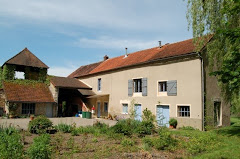
As mentioned earlier, this area is rich in culture. The many old, Romanesque churches are good examples of this heritage. All churches are owned by the state, and as in many other countries, the Roman Catholic church is loosing its grip on the masses. The result is that many churches only have a church service once every month, if not less often. Luckily, because the state owns the churches, they are sometimes used to host other venues, such as concerts. A beautiful example is the Church of St. Martin in Chapaize. It is still in use for services every so often, but on Saturday evenings throughout the summer it is used as a concert hall. Recently the volunteers organisation of Chapaize Culture had organised a concert here.
Click here for the website of Chapaize Culture
The theme of the evening was Baroque music, performed by an orchestra in period cloths. The company was called “Les Symphonies du Roy conducted by Daniel Ribolet. On the program there were compositions of Charpentier, Lully, Telemann, Rameau, Corelli and Bach.
This small orchestra had an interesting composition. There were 6 reeds (5 oboes and 1 bassoon, 4 brass (3 trumpets, 1 French horn) and 1 percussionist (kettledrums). There was a master of ceremony, or narrator, who introduced the pieces. He was dressed in a livery, with a long, white wig. The musicians were dressed in the uniform of the Musqueteers of the French king. After each piece they were supposed to stand up, put their hat with feathers on, bow to the audience and take off their hat very elegantly, the 17th century’s way. Fortunately they played better than they bowed.
The orchestra, although clearly an amateur orchestra, played with gusto, and in general quite well. Only 2 of the brass players had every so often some trouble in keeping up with the rest, in terms of rhythm and tempo as well as in terms of melody. This was distinctly noticeable in the Corelli Sonata for brass only. The director, one of the oboe players, is a teacher at the music school in Montceau-les-Mines, and certainly the other reed players were most likely some of his more gifted students.
In general one can say that the concert was a very enjoyable one.
Not all concerts given here are performed by French musicians. Because there are a lot of Dutch and Swiss people living around here, either permanently or temporarily, there are regularly concerts by Dutch and Swiss ensembles as well. Certainly the madrigals performed by a Dutch choir still sticks in my mind, not in the least because of the superb acoustics of this church.
The only drawback of this venue are the church seats. Even after five minutes I will develop an acute back ache; however, we bring our own cushions, which makes “sitting” out a concert possible!

The website of La Tuilerie de Chazelle

Saturday, 27 June 2009

Guitares en Cormatinois 2009

The website of La Tuilerie de Chazelle
Blog of La Tuilerie de Chazelle by Sue

Cormatin hosts two major cultural events each year; firstly the Festival Guitares en Cormatinois, and secondly Les Rendez-vous de Cormatin, a theatre festival at the Château de Cormatin.
The first (music) festival is in full swing at the moment. The first two concerts took place some weeks ago, and there are still three more to go. For the first time this year the Festival is spread out over a number of places. In previous years the festival was held in the church of Cormatin, a rather boring building compared to the treasures of Romanesque architecture that can be found in the area around us.
The first concert in the series, a classical concert by Emmanuel Rossfelder was in the beautifully restored church of Malay. This concert, with works by among others Tarrega, Villa Lobos and Bach, was coinciding with the Concours départemental de guitare, the guitar competition for Saône-et-Loire (71). Of course Rossfelder was one of the jurors, as was another outstanding musician from around Cormatin, the classical trumpet player Guy Touvron. Rossfelder’s concerts are always enjoyable, and the surprise of this recital was his own arrangement of some highlights of Verdi’s La Traviata.
Would you like to hear him? Click here to go to Rossfelder’s website
The second concert was an open air concert by a group from Lyon called Zancle. They played a repertoire of Napolitan and Sicilian folk songs. The group consists of four musicians, playing a wide range of guitars, mandolin, flute, accordion and different tambourines. Two of the four man sang as well. The concert was given at the Plan d’Eau in Cormatin. The Plan d’Eau lies at the edge of Cormatin, and consists of a small lake and a branch of the local river Grosne. In the daytime it is an ideal picnic place, but for this evening it was transformed into an open air concert hall.
What strikes me time after time with all the events in Cormatin, is that there is a small group of volunteers who takes care that everybody has a good time. The wife of the Mayor, Monique B., is always there, selling drinks, making wafers, preparing sandwiches; another one who is always present is Pascale P., a very energetic lady who in the daytime paints wonderful pieces of silk for dresses, and is also a council member of the city council. We do not know everybody by name, but for sure all the regulars were helping out, selling and checking tickets, moving chairs, setting up tables, etc.
The strange thing I have noticed about a lot of concerts here in France, is that the musicians tend to go on. More often than not there is no break in the middle of a recital, and concerts of two hours in one go are no exception. The Zancle concert was following this concept. After an hour Mme B. and her crew were getting a bit restless, which got worse when it got later and later. They were going to make wafers, hotdogs, etc., but no pause, no clients, no selling of drinks and snacks …. Anyway, finally the last notes sounded of this very enjoyable concert, and of course half the crowd turned around and headed for their cars. Luckily for Mme B. & Co there were some diehards, who stayed a bit longer for a drink, and there were even people who bought some wafers to to take away!
The last concert in this series of five takes place in the Romanesque church of our own hamlet, Chazelle, and we will certainly be there and write another review.